1993 Ousley Family Reunion
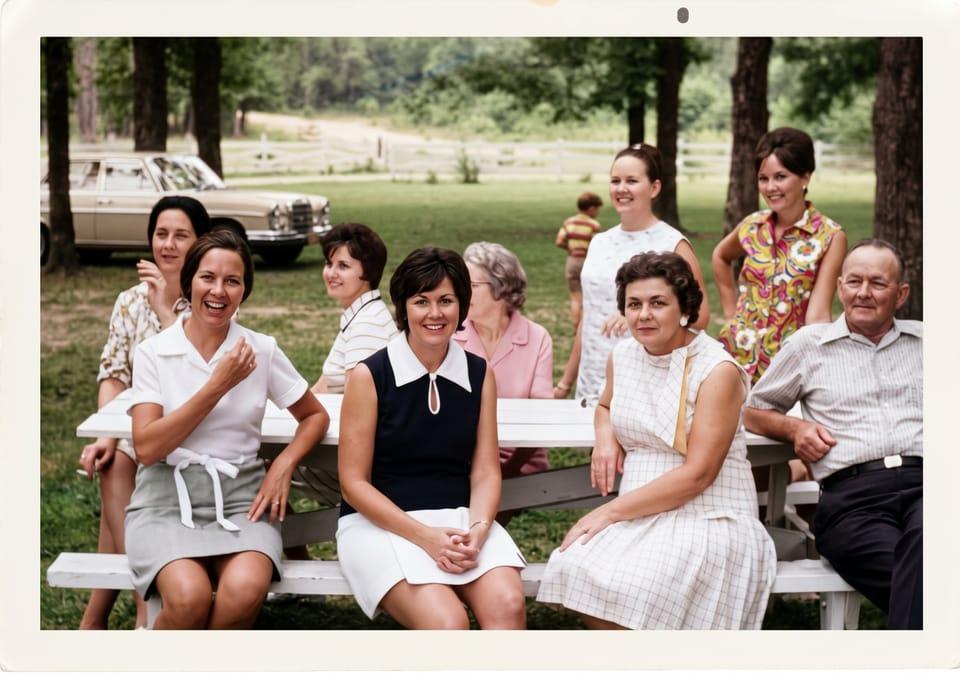
At 5:00 a.m. on Wednesday, June 9, 1993, our bedside radio turned on, waking us up. Frances and I got up and hustled about dressing. After a cup of coffee, we checked the house, locked the doors, and drove off at 4:05 a.m., beginning our trip east to the Ousley family reunion in Birmingham, Alabama.
Our first stop was breakfast at McDonald's in Beaumont at 6:00 a.m. The restaurant was dirty and the food tasted like cardboard. We won't stop there again.
We felt good crossing over the Sabine River from Texas into Louisiana. Louisiana attracts me. My pulse quickens, and I find myself growing excited just passing through. I don't understand why. The foreign flavor may have something to do with it. And yet, Louisiana is as comfortable as a pair of old shoes. The culture is a smorgasbord of African, British, Caribbean, French, Indian, and Spanish influences. From this racial polyglot comes unique music, wonderful food, and a happy-go-lucky, spit-in-your-eye attitude. Self-conscious and inhibited are adjectives that do not apply in Louisiana. Cajuns are sybarites, one and all.
We traveled across the southern part of the state, deep into the heart of Acadiana. Boozoo Chavis entertained us (on the radio), playing Zydeco. "Goin' To La Maison," "Oh Yae Yae," and "Don't Worry About Boozoo" kept us tapping our feet and in high spirits as the miles rolled by. Lake Charles, with refineries belching smoke and steam, gave way to Jennings, Crowley, and Lafayette, and then to the Atchafalaya River. Magnificent water oaks lined the road, watching the traffic like mandarins.
Soon we entered the region known as the "Sugar Bowl of America." Large sugar plantations extend over 30 miles west from the Mississippi River. When the US stopped importing sugar from Castro's Cuba in 1960, this industry sprang to life. Then, we were on the Huey P. Long bridge, high above the Mississippi, with the Cressida climbing smoothly in cruise control and coasting down into Baton Rouge on the east bank.
Some time ago (1699), a French explorer named the site "red stick." The name referred to a tall cypress tree draped with dead animals. The tree marked the boundary between the hunting grounds of two Indian tribes. Today, Baton Rouge is the northern end of the Petrochemical Gold Coast, which extends 100 miles downriver to New Orleans.
I am fond of Baton Rouge. It suits me. I love the magnolia trees and the quiet, comfortable neighborhoods. For all of the laid-back feeling, one has never truly experienced a college football game until they have been immersed in "Tiger Stadium," home to the LSU Tigers. During a fall afternoon of mayhem on the field and partying in the stands, the energy and enthusiasm of the crowds are astonishing.
Our route took us north of New Orleans. I could feel the seductive pull of this magic city, 30 miles to our south, as we passed through Hammond on our way to Bay Saint Louis, Mississippi.
We stopped to gas up. We had traveled about 400 miles. The Cressida averaged 24.5 MPG—not bad considering we were cruising at 70 MPH with the air conditioner cranking out oceans of cool air to counter the 95°F outside temperature. Our trip speed average was 53.8 MPH. I thought this was outstanding. We disciplined ourselves to minimize time spent not moving.
Near Biloxi, we stopped at a roadside park for lunch at 12:15 p.m. We were fortunate to find a table near a large tree. The shade and a gentle but steady breeze helped cool us. I had been anticipating this lunch. Frances had cooked fried chicken and whipped up a great potato salad. She included cheese, olives, kosher dill pickles, stuffed celery stalks, and home-baked Irish soda bread. We had a feast and took our time eating it. We talked about other roadside picnics 20 years ago when Rod and Dav were children. How they used to run and laugh and play with Chips while we watched as proud parents do.
After lunch (a 20-minute stop), we motored off due east to Mobile. Bypassing the city, we turned north towards Montgomery, 150 miles away. At Montgomery, we were only 55 miles from our destination—Alexander City, Alabama.
Fran played the Phantom of the Opera CD as our interstate, divided, four-lane highway narrowed into a two-lane state road. Kudzu covered both sides of the road in a sea of green that extended high up into the trees. There was a hint of honeysuckle fragrance in the air left over from the spring flowering. The music and the road, twisting and turning, moving in and out through deep woods, hinted at mystery and adventure. We flew down the straights and "gonzoed" around the turns and up the hills. Although I was tired, I felt good in a "coming home" sort of way.
The receptionist checked us into the Horseshoe Bend Motel at 5:15 p.m. It was accent—flat with a nasal quality. Her poor grammar didn't help. We concluded that she was bored and sleepy. Most likely, she had never lived away from this part of southeast Alabama. I felt sorry for her, someetimes rural life can produce dullness of mind and spirit.
We finished off the remainder of the food from our picnic, cleaned up, and read for an hour before going to bed. Getting to sleep was a problem. I tossed and turned. Our room faced the highway less than 50 yards away. Trucks roared by, growling and squealing as brakes were applied and gears shifted. The racket was incessant until about 11:00 p.m.
The next morning, I was up early, ready to explore. We had a 9:00 a.m. appointment with Shirley Satterfield (a real estate agent). Waiting for Shirley, I reflected on what I want in retirement. I am torn between a small town like Meridian and living in the country near Birmingham. Retirement demands more thought than I have been giving it.
Shirley worked hard, showing us around the city and Lake Martin. The part we saw seemed to be designed for upscale yuppies from Birmingham, Montgomery, and Atlanta. I am not looking for a $150,000 weekend retreat. We departed Alexander City for Birmingham that afternoon. Birmingham is just 67 miles away on Highway 280. We arrived at Johnson's Jewelry at 4:15 p.m.
Aunts Lilian, Catherine, and Mildred welcomed us with open arms. I was touched by how happy they were to see us. Seeing and listening to them woke up old memories. I remembered happier times when my uncles Claud, John, and Jim were alive, and the world seemed young and fresh. Now, my aunts are old and alone except for each other. High spirits and laughter have been replaced by occasional smiles and gray hair. Time passes quickly.
That evening, we ate at Quincey's. We reminisced. We had a good time. I hope I age as gracefully as my aunts have.
Aunt Lilian is in poor health and has difficulty moving about. Aunt Mildred tries to have fun, but behind her brightness, care and concern show through. Aunt Catherine still mourns her husband's passing. Adding to her sadness is the recent loss of an old and dear friend. Taken together, these events have dampened her spirit. On the bright side, Aunt Benny's marriage to Cousin Bill has been good for both of them. The evening was enjoyable, but there is the unspoken awareness of how little time is left for the old Johnson family.
Friday morning, June 11, 1993, I woke up early as usual. I slept well at the Budgetel on Highway 280 South. The motel is new. The rates are inexpensive. I watched the weather report on TV as Fran got dressed. The weather is supposed to be a carbon copy of yesterday—hot, with the temperature in the mid-90s, and very dry. Everyone prays for rain.
Dad and I spent the day going about the city. We saw his boyhood home in Norwood and met some of his friends. We talked and talked some more. He told stories that I've heard dozens of times. I listened as never before. I was affected deeply when he told of meeting my mother for the very first time in typing class. His voice took on a wistful quality when he told how radiantly beautiful and full of life she was. He couldn't take his eyes off her. He was eighteen, and she was fifteen. The year was 1928. I looked away when he coughed and wiped his eyes.
Being depressed in Birmingham comes naturally to me. Everywhere I turn, something reminds me of departed loved ones. Every building, road, and tree is familiar yet different. I find myself wanting to recreate the past. Of course, I can't. The people that made my growing up so special are gone. Now, 41 years later, I am a stranger. Coming back is bittersweet.
Would I be better off if I had never left? Who knows? We have no control over fate. We are drawn into a whirlwind, tossed about, and thrown out—suddenly. What happened? Was it all a dream? We don't know. One day we are vigorous, full of life, and looking forward to the future; in a wink, we are old, tired, and confused.
Friday evening, Aunt Benny and Cousin Bill Duke invited everyone over for dinner at their home on Double Oak Mountain, south on old Highway 280. Bill and Bennie's home is a brick, two-story with four columns supporting an overhanging roof in front. The structure is simple, upright, and elegant. The house sits on about three acres. Tulips, roses, and azaleas show off the house to advantage.
A massive oak tree stands by the driveway entrance. I thought that it must be over a hundred years old. Bill said that his father planted it in about 1915. Today, it is seventy-eight years old and a magnificent example. In back of their house, they have a beautiful garden full of roses and fruit trees.
Aunts Benny, Mildred, Catherine, and Lillian prepared hot dogs and baked beans for us. We laughed and told jokes. I thought how fortunate I was to come from such good stock.
I slept in Saturday morning. I wrote while Fran got dressed. She took her time. I'm glad that Fran is particular about her appearance. We departed about 11:00 a.m. for the forty-minute drive to the site of the reunion in Bessemer at the Best Western.
As we arrived, I noticed that everyone was stiff and stand-offish. I imagine one should expect even relatives to be reserved when they haven't seen each other for a year or more. The men talked about sports and the weather. The women talked about children and babies. The kids screamed and shouted—a fairly typical family reunion.
Most everyone (staying there) was unhappy about the accommodations at the Best Western. The facilities were old and run down. The air conditioning was marginal in some of the rooms. The Birmingham contingent of the Ousleys could have found a better meeting place.
Lucile, Tom, Phil, Lamar, Fran, and I went exploring to Birmingham's Botanical Gardens and to see Vulcan. I pointed out some long-abandoned iron ore mines dug into the north face of Red Mountain. I had many happy days wandering the mountainside with my BB gun while dreaming of daring-do exploits. We rode the elevator to Vulcan's observation deck and looked out over the city.
What a marvelous sight. The city lay stretched out before us to the north. From West End to East Lake, from North Birmingham to the south side, this was the epicenter of my boyhood world.
At the Botanical Gardens, we happened upon a June outdoor wedding in progress. The bride and groom looked very traditional. He wore a tuxedo with a white jacket. The bride wore a dazzling white gown. I had almost forgotten how elegantly people can dress. The gardens were beautiful and much expanded from when they were created over twenty years ago.
We had fun sightseeing. We drove through the neighborhoods in Vestavia and to see Grand Dad Johnson's restored home on Pumphouse Road. We stopped by Benny and Bill's before returning to Bessemer and the reunion dinner.
The dinner was typical of most large, sit-down affairs. The service was cafeteria-style. The food was tasteless.
A representative from each family present spoke about where they were from and what was happening in their lives. No one was prepared. The speeches petered out early. Obviously, little effort went into organizing this reunion. The party broke up about 10:00 p.m. A few more affairs like this, and there won't be any more. They'll be canceled for lack of interest.
The next morning (Monday), we purchased picnic supplies and flowers for Mr. and Mrs. Ousley's graves at Bethel Church in Cyril, Alabama. Lamar, Evelyn, Tom, Lucile, Fran, and I drove to Cyril.
The seven sisters and their families met Sunday morning at Jolene's house in Riverchase. We visited all day and had a great time. This is what a reunion is all about. Dad came over. We sat alone on a bench outside and talked some more. We talked about the past and the present. Dad told me the story of his Uncle Burnet (his mother's brother) committing suicide. He didn't have financial problems or family troubles. No one knew what despair drove him to take his life.
Fifteen years later, his wife and widow was murdered in her home. The police speculated that a Black workman who had just painted her house killed her. There was no evidence connecting the Black man to the crime, and he was released from custody. This event occurred in the 1940s. It was a tragic family story. I am not sure that I have the details down accurately; Dad's memory is dim.
The sun had locked the temperature in the mid-nineties by the time we arrived. There was no breeze. Thankfully, the humidity was low. We organized our lunch under the old canning shed at the church. As we ate, Lucile and Evelyn recounted stories from their childhood in this area. Evelyn kept me in stitches, telling how she pulled another girl's hair. It seems that this girl was picking on Lucile (Evelyn's little sister). This was in 1933. How innocent those days now seem.
When we finished, Fran placed her flowers on her parents' graves. It was a small gesture, but it meant much to her and Evelyn and Lucile. I could feel their sadness and longing.
We walked over the ten acres that Mrs. Elsie Allen Ousley inherited from her parents. I enjoyed the solitude of the woods. The trees seemed to close up about me, offering what shade they could. Fran and I stopped on a bridge over a small stream. We held hands and watched insects play on the water. Neither said anything. We were lost in our private thoughts.
We left Jolene's party about 4:00 p.m. to drive to Meridian. Saying goodbye to Dad was very hard for me. Each time I see him, he appears more frail.
In Meridian, we checked into the Holiday Inn. An east Mississippi Black convention was being held there. The Blacks were of an older generation. The women wore white, uniform-like dresses. The men wore ill-fitting suits and hobbled about as if their feet hurt.
Strolling by the convention room, I stopped and listened to a Black speaker haranguing his audience. After a loud, emotional plea accompanied by much arm-waving, the people swayed back and forth and side to side. I did not understand what he was talking about. It was just mumbo-jumbo to me. Near the door was a bulletin board with several hundred snapshot pictures posted on it. At the door was a guard dressed in combat fatigues and sporting a pistol. I presume that he was their security. What the group was about, I have no idea.
We departed about 3:00. Tom and Lamar rode with me; Lucile and Fran rode with Evelyn.
We dined quietly at Evelyn and Lamar's new home that evening. After eating, we discussed politics. Now, that's dangerous to good family relations. Tom and Lucile Sofge, being a retired Methodist Bishop and his wife, are, almost by definition, liberal Democrats. As a die-hard, conservative Republican, I love tweaking liberal, Democratic noses. For instance, when the conversation turned to the recent election, I couldn't resist raising an eyebrow at Tom and Lucile and asking, with a mischievous grin, "So, how do you feel about the current state of the Democratic party?"
Tom, ever kind and sensitive to others, simply smiled and said, "Well, Cal, we all have our own perspectives." He preferred to keep his opinions to himself, but Lucile, Lamar and I dove headfirst into a spirited discussion. Evelyn, Phil, Fran, and Tom would occasionally interject a comment, adding fuel to the fire. I always enjoy a good debate, especially with family. There's something about the cut and thrust of political conversation that gets my blood pumping.
We departed for Houston the next morning. The return trip was uneventful, a quiet contrast to the whirlwind of emotions and memories I carried with me from Birmingham. As the miles rolled by, I reflected on the reunion, the visit to my parents' graves, and the poignant conversations with my siblings and Dad. It was a bittersweet trip, filled with laughter and sadness, joy and regret. But most of all, it was a reminder of the enduring power of family ties, even in the face of time and distance.
Member discussion