Going to War
The dog dung of doubt clung to every story line I constructed so carefully in my mind. How exactly do I tell Frances? What can I say, when should I say it and what would she think? Those thoughts had been troubling me for about five days since I had spoken with my good friend, Bill Drury. Bill was serving in the Bureau of Personnel (BuPers) branch of the Naval Supply Systems Command (NavSup) in Washington.
Bill had asked if I would consider volunteering for duty in Vietnam as a relief for another good friend, Bill Aldenderfer, due to rotate home in April 1968. Since the time was late September 1967, I had only a few days to consider my decision. If I opted to go, I had to attend the Marine Corp three-week Escape and Evasion course in Little Creek, Virginia and the Army's two-week Petroleum and Lubricants course at Fort Lee, Virginia. The Marine course was hurry-up, run, jump, swim, shoot'em-up training designed to prepare one physically and psychologically for combat. The Army course taught how to operate and maintain refueling facilities used ashore in hostile areas. (Both courses proved worthwhile, as I was to find out later.)
If I said yes, the wheels would be set in motion to relocate my family [Fran and Rod (5 yrs.) and Dave (2 yrs.)] back to the states, take some leave and be in Vietnam by April 1968.
How do you tell your wife that you're volunteering to go to war? What possible arguments can justify your decision? I could say: I am a professional military officer and war is what I've been trained to do; It will be good for my career, I've been receiving my government's pay for eleven years and when she calls, I'm obligated to respond or I could point out that there were only six officers in the Navy with my specialty and I was needed. However, I suspected that all my reasons might sound contrived to a young wife raising two small children and forced to live apart from her husband for a year.
At the time (September 1967), I was assigned to the J-4 Logistics Directorate of the U. S. Southern Command (SouthCom) located at Quarry Heights in the Canal Zone, Republic of Panama. Frances worked as a secretary to Col. Pamplin (J-1 Personnel Directorate) of SouthCom. We were just settling in, having arrived in May 1966; and we enjoyed the extra money her civil service job provided. Having a caring, live-in maid, who looked after the boys during the day, eased Frances’ worries about being an absentee mother. Although my job as the Joint Petroleum Officer kept me traveling two out of every four weeks throughout Central and South America, life was predictable and fun. We had made many good friends with the Army and Air Force officers on the joint staff.
Here we were enjoying a comfortable life, and I was about to turn everything upside down. It crossed my mind to not say anything, lie and act surprised when my orders came. Somehow that seemed cowardly. I didn't want an important decision affecting our marriage to rest on an untruth. I don't remember our conversation about going to Vietnam word for word, but it went something like this:
“Honey, we need to talk,” I said one day after work, not being able to put it off any longer.
“What about? … I've noticed that you've been distracted for the last few days…has something bad happened?”
I blurted out, “I want to go to Vietnam. I'm needed there… I've hesitated about telling you… I was worried about how you would react… I need your understanding and support. Bill Drury at BuPers is waiting for my answer.”
“How much time do you have before telling them?” asked Frances.
“A few days at most. If I agree to go, we'll get orders in a month or two,” I said.
“Where will Rod, Dave, and I stay while you're there?”
“Let's talk about that…do you suppose your Mom and Dad would mind if you lived with them while I'm away?”
“I don't think so, but I should ask them. I'll telephone Mom and Dad tomorrow.”
Once the shock had worn off, the floodgates opened and the tears came. I suppose she felt abandonment, hurt, and anger that I could leave her and expose myself to risk when it wasn't absolutely necessary. Nevertheless, the die was cast. Fran called home; her mom and dad said yes, they would love to have her and the boys live with them. I called BuPers, and within sixty days, I received orders to the Naval Support Activity in Da Nang, Vietnam, with temporary additional duty orders to the Marine Corps School at Little Creek and the Army School at Fort Lee. I was detached from SouthCom in February 1968.
Returning to the states and visiting my father and mother in Birmingham, I learned that Mother was dying from cancer. I knew that she had been ill, but I didn't know how desperate was her condition. I'll always remember the conversation I had with my father and mother's physician, Dr. Rett Barnes. Dr. Barnes was a close family friend that I had known since childhood. He explained that mother's cancer was terminal and that she had only a few months to live. Leaving Mother and Dad, not to mention Fran, Rod and Dave, was one of the saddest moments of my life. (Mother died in May 1968, about three weeks after I was in Vietnam. I couldn't attend her funeral.)
When I completed my training at Little Creek and Fort Lee, Fran flew from Mississippi to Virginia to meet me. We had a brief but marvelous five-day vacation in Colonial Williamsburg. I recall that bittersweet interlude often. We didn't mention Vietnam once. We both understood the uncertainty of what lay ahead; however, we tried to be positive and upbeat.
I began the long journey (eight time zones to the west) to Vietnam by air in late March 1968. I flew by military commercial charter from Los Angeles to Clark Air Force Base in the Philippines. There, I laid over for a boring 12 hours in the terminal with hundreds of officers and enlisted men awaiting onward [to the east (US) or west (Vietnam)] transport. Eventually, I arrived at Tan Son Nhut airport near Saigon. At Tan Son Nhut, I boarded an ancient C-47 transport for a two-hour flight north to Da Nang.
From the moment I boarded that aging, twin-engine, camouflaged bird, I knew that everything was different. Small shafts of light from bullet holes crisscrossed the interior. As my eyes adjusted to the dimness, I noticed the detritus of battle—live rounds, spent shell casings, empty M-16 magazines, a bloody sock, piles of soiled bandages, cast-off canteens, stubbed out cigarettes, metal ammo cans and eight blood-soaked stretchers scattered about the floor.
My most vivid impression of the darkened interior, however, was the unique smell of battle. I had never experienced it before; yet, I recognized the odor. I nearly gagged. There was the sour, nasty BO of unwashed bodies, the stench of fecal matter and urine and the strong acrid smell of burned gunpowder. Perhaps worst of all was the sickly, sweet aroma of decomposing blood and human tissue. It was hard to breath in the heavy 105°F interior air. This was my welcome to Vietnam as the infamous 1968 Tet offensive wound down.
Deplaning in Da Nang about 1:00 p.m. local time, I was met by a smiling Bill Aldenderfer. Off we went for a whirlwind tour of the fuel facilities in and near Da Nang. I had been in a travel status for about forty hours when I arrived in country. I was groggy from lack of sleep and passing through eight time zones. I had trouble concentrating. I met Lt. Roy Huddleston, my number 1, and many of the 53 enlisted personnel assigned to Bulk Fuels, Naval Support Activity (NSA), Da Nang.
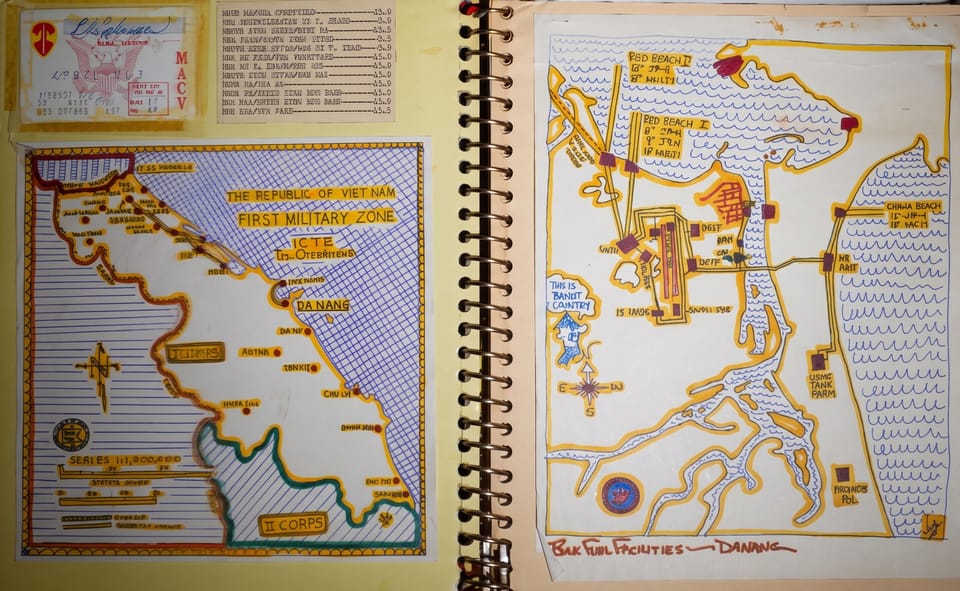
Bill took me to the NSA Headquarters at the "White Elephant" where I reported in and met my boss, Capt. Wes McClaren. Capt. McClaren briefed me about our mission and stressed what was expected of me: no combat unit in I Corp was to run out of fuel, ever. If they got to a refueling point, there had better be fuel and plenty of it.
NAS Da Nang supported military activities in the five northern provinces of South Vietnam known as I (eye) Corp. NAS provided everything (ammo, repair parts, food, clothing, medical care and fuel) required by about 195,000 US and allied forces operating in those provinces. Da Nang in 1968 represented the Navy's largest overseas shore command since WWII with about 10,000 officers and men assigned.
I was responsible for all POL (petroleum, oil and lubricants) consumed by the US and allied forces in I Corp. Our fuel arrived in tankers and was offloaded through seaload lines into 50,000 barrel (42 gal per bbl) storage tanks at Da Nang and Chu Lai. We transshipped most of the fuel by LCM 8 bladder boats along the coast to Cua Viet, Thon My Thuy (Army base) and Tan My. At those locations, the fuel was stored in 10,000-gallon rubber bladder bags arranged in a five-bag circle (star fashion) in scooped out trenches. Some fuel moved through above ground pipelines from Tan My to Phu Bai and from Dong Ha to Quang Tri. Only tank trucks could resupply some remote points. In all, I Corp consumed about a million and a half gallons per day and even more during intense operations. We never had more than six days supply at our outlying bladder farms. It was a juggling act of coordination to keep our refueling points topped off.
Without fuel, the U.S. military machine becomes a helpless puppet because it can't move. In modern war, those who can't move die. Our motto was, "Where Would You Go Without Us?"
About 2300 (11:00 p.m.) Bill dropped me off at a small hotel in Da Nang used by our military as temporary living quarters. I had no sooner begun unpacking than an alarm sounded. I ran to my assigned station at Adm. Osborn's (Commander, NAS Da Nang) quarters about a city block distance. It was an old, French provincial, two-story home with a flat roof.
The Marine Gunnery Sergeant heading Adm. Osborn's security detail told me that he had 8 marines and that we were the only ones present in the house. He said we had radio contact with his unit and they could provide helo gunship support within 15 minutes of a call. We toured the house. Gunny took me to the roof and introduced me to the four marines servicing an M-60 machine gun overlooking the street. On the ground floor, actually about 8 feet above ground level, there was another M-60 manned by two marines in a sandbagged bunker in the front foyer. Gunny asked me where I wanted to be. We decided that the roof would offer us the best vantage point.
We heard explosions in the distance several miles away. Then, without warning, a heavy volume of automatic weapon fire broke out close by and the night was no longer still. Tracers arced back and forth, followed by the flash-bang thumps of exploding grenades. By radio, we learned that the South Vietnamese Police Station (two blocks south of us) was under attack by an unknown number of VC (Viet Cong). This got our full attention. Without being told, two marines began distributing additional ammo and grenades at every defensive point in the house.
Try as we might, the gunny and I couldn't see the police station because of many trees lining the street. I remember thinking, this isn't the "let's pretend" cowboy and Indian battles of my childhood. It is real and people are dying. We could be next.
As quickly as the firing began, it stopped, having lasted less than twenty minutes (it seemed much longer as we waited on the roof). We stayed at our station another three hours. When the all-clear sounded, we were told that the area was secure and to stand down. I walked alone to my hotel through deserted, darkened streets. I recall thinking: is it better to walk down the middle of the street so no one can surprise me or to move along close to the buildings? I chose to move from tree to tree near the buildings. I don't think I've ever been as alert and scared as I was walking that short block at 0400 clutching my M16. Thus, my first day in Vietnam drew to a close.
Member discussion