Shore Leave As A Midshipman pt II Paris
We (Al, Kevin, Jimmy, and I) talked while waiting to board the train that would take the New Jersey's 200 midshipmen from Vigo across country north to the port of Coruna, 100 miles away. We didn't discuss the most publicized events of 1954: Roger Bannister breaking the world record by running a sub-four-minute mile; the launching of the world's first atomic-powered submarine, the Nautilus. Nor did we speculate about the French defeat by the Viet Minh at Dien Bien Phu, Vietnam, and no one brought up Joe DiMaggio, the Yankee Clipper, marrying Marilyn Monroe, every man's blond dream.
What we did talk about in that long-ago summer was the unfairness of liberty expiring just as Spain was waking up for a good time. Nevertheless, going ashore did give us some relief from Lt. Cdr. Thurston B. Rhoades, better known as "Thirsty for Blood," or just plain old"Thirsty." So far, he had made our lives miserable. He taught by ridicule and held in contempt those guilty of minor infractions. For sure, we loathed Mr. Rhoades of Boston, Massachusetts, for his pettiness and the smugness of his assumed New England superiority.
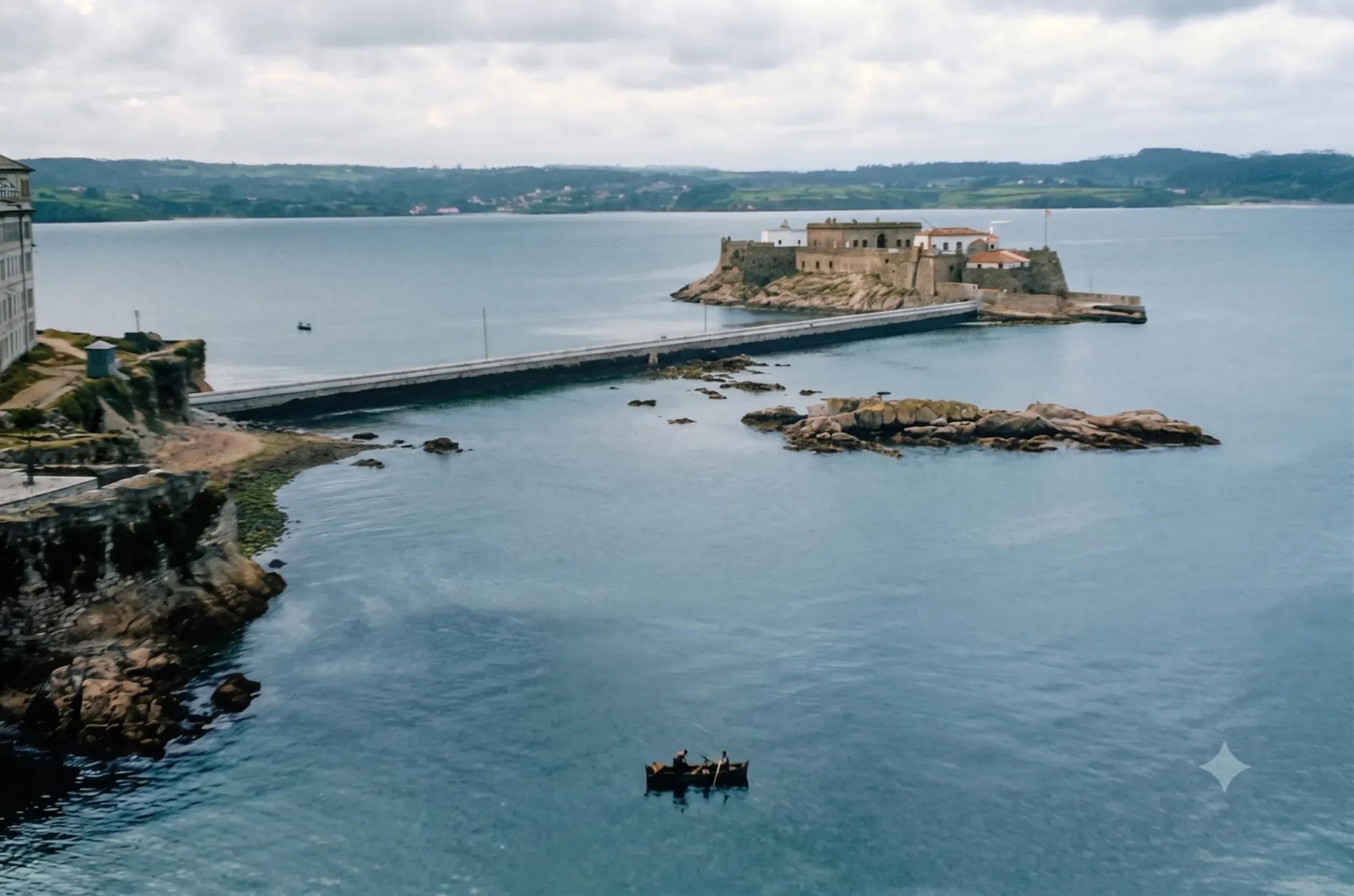
We appreciated opportunities to get off the ship and enjoyed visiting in Spain. The kindness, simplicity, and quiet dignity of the people touched us, for most were friendly and went out of their way to be helpful. Yet, we questioned if a motor scooter really cost locals the twelve pesetas per hour we paid (I don't recall the exchange rate).
We were curious: Were Spaniards reserved and orderly because of Franco's Guardia Civil police? They appeared sinister dressed in dark green uniforms, black jackboots, and funny, shiny, black hats with the brim turned up against the crown in back. Wherever we were, they hovered in the background in groups of twos or fours—watching, always watching. The people ignored them but gave way quickly when meeting on a sidewalk.
Jimmy commented, "Those guys act more like soldiers than police—why do they need sub-machine guns, extra magazines, and pistols?"
"Who knows? I don't like it," said Al.
Boarding the train for Coruna with a liter of wine, we settled into playing cards. The train chugged along leisurely, rocking gently from side to side. We arrived sleepy and tipsy but prepped for a late afternoon of sightseeing.
We strolled about the city square, window-shopping, taking pictures, and girl-watching. We browsed in the city's museum and, later, visited a large cathedral. At 4:00 p.m., there were few people about, so we rested and had coffee at a cafe. That evening we dined at an elegant but deserted hotel dining room off the square. The maître d'hôtel informed us that the locals didn't eat before 10 p.m. For us, liberty expired at 11:00 p.m. (The New Jersey had steamed along the coast from Vigo and was waiting for us.)
Early the next morning, the New Jersey weighed anchor and got underway for Hamburg. During the voyage up the French coast, through the English Channel and north to Germany, our shipboard battle drills were relaxed in favor of seamanship and navigation exercises.
In spare moments, officers lectured on the political tensions building between the East and West. In those days, people talked about the first world (Western Democracies), the second world (Communist countries), and the third world (all other non-aligned and mostly poor nations). They emphasized that we should represent our nation well by being gentlemen and not provoking incidents with foreign nationals.
Every evening after dark, Kevin, Al, Jimmy, and I would take star sightings and attempt to plot the ship's exact position. Working in pairs and employing a sextant, we had to take three star sightings, note the precise times, copy numbers from the star tables, do the math, and draw three lines on a chart. If done correctly, the lines intersected at one point—the ship's exact position. But any small mistake in recording the time, misreading the sextant angles, transposing a number in the tables, or making a math error would result in a triangle of several inches per side. We'd have to do it all over. We learned that accuracy and detail are the twin gods of navigation, and we were their slaves. Getting a fix was tedious and laborious. Sometimes, it took Kevin and Al hours before they pinpointed our position. Jimmy and I had an easier time.
The last night at sea before Hamburg, Old Thirsty was our navigation instructor. For some reason, Thirsty took a dislike to Kevin. Kevin thought it was because he was a poor "Mick" from South Boston, whereas Thirsty Rhoades fancied himself an upper-class New Englander.
On this particular night, Kevin and Al had more trouble than usual plotting the position. Thirsty wouldn't ease up. He harassed them for the entire watch. The harder Thirsty pushed, the more Al and Kevin got flustered. Thankfully, the oncoming mid-watch relieved us, and we headed for our sleeping compartment.
Once out of Thirsty's hearing, Kevin vowed, "I'll get that sorry ass bastard."
"Calm down, Kevin. Don't be stupid, you could lose your scholarship," said Jimmy as Kevin continued to threaten Thirsty.
"Drop it, Kevin. Stay out of the S.O.B.'s way."
"Cal, Mr. Thirsty f**ing Rhoades has given me hell all cruise. I'll see he gets his."
I thought no more about it. Kevin was just letting off steam. The next day we were off the mouth of the Elbe River at Cuxhaven, the gateway to Hamburg, our next port of call.
For hundreds of years, dating from 1292, Hamburg has been a thriving commercial center for northern Europe. A major port and industrial center (shipbuilding, oil refining, chemicals, machinery, and electronic industries), Allied bombing had destroyed the city during World War II. Nine years later, the New Jersey steamed fifty miles slowly up the Elbe, with the crew at parade rest lining the sides.
Devastation on both banks of the river extended for mile after mile. It was horrific. Scarred trees and weeds heightened the pathos of burned-out buildings. Blackened, twisted, broken, and rotting machinery littered the landscape. From Cuxhaven to Hamburg, our bombers had pulverized everything, leaving nothing but crumbling ruins. We observed on deck for hours, staring in awe and disbelief.
We wouldn't have much time to see the city. The next morning, half of our contingent—about 100 midshipmen—would boarded a train for Paris and three days of fun and sightseeing. When they returned, those left behind would go to Paris. Not wanting to jeopardize our trip, we returned to the ship early. Besides, walking about Hamburg, where no one smiled and most averted their eyes in passing, was depressing.
"What's the matter with these people?" asked Jimmy. "They look so sad and dejected."
"I suppose they are still suffering from World War II."
"But the war has been over for nine years—you'd think they would have put it behind them."
"It may not be so easy if you've lost your family and all you own."
"I don't feel sorry for the Nazi pricks," said Kevin. "They deserve every bit of their misery."
Walking around the city, we saw block after city block reduced to rubble dumps. Shabbily dressed old women with rags wrapped around their hands crawled over mounds of debris, digging out bricks. They would cast aside broken ones. Using a chisel-like piece of metal, they knocked off remnants of mortar from whole bricks. These they stacked in neat piles, for resale, I suppose. They never looked up as they returned again and again to the piles for yet another brick to be reclaimed. I shuddered to think of my mother and aunts having to work at such a hard and humbling task.
We drifted into a small eatery, ordered sandwiches, had a few beers, and returned to the ship. Unlike the movies, we found no crowded beer halls with revelers singing lustily and swaying to and fro, row by row. No, the misery of the people was palpable. I didn't enjoy the time ashore; it was too troubling.
At quarters the next morning, Thirsty Rhoades passed out train tickets to Paris and hotel assignments. He warned us to report to our hotel immediately upon arrival. We were not to keep him waiting. He would be there to vouch for us because we didn't have passports. In those days, all foreign visitors to France had to surrender their passports when registering for the night. The French government made an exception for American military personnel accompanied by an officer.
We were billeted two to a room in five or six small hotels scattered about Paris. Each hotel took in fifteen to twenty midshipmen. Thirsty assigned all sixteen in our watch section to the Hotel Duville, where he and his wife were staying. Six wives of our training officers had flown to Europe. Traveling together, they rode trains and used automobiles to meet their husbands at each port of call.
Getting off the train in Paris, the station appeared enormous, with hundreds of people milling about. As we tried to puzzle out the subway map to get within walking
distance of our hotel), three English girls asked if we needed help. We accepted gladly and invited them for coffee and ice cream afterward.
They said that they were from Manchester, UK and were on a ten-day holiday to the south of France. By now, we had lingered at the train station for about forty minutes. Jimmy, Al and I were anxious to get to our hotel. Not Kevin. He tried to arrange a date later that night; the girls declined. They had tickets to Aix-en-Provence and hotel reservations that couldn't be changed.
When we walked into the Hotel Duville's lobby, Thirsty was waiting. He wasn't in a good mood. As we signed the register, Thirsty began another smug lecture on conduct. He threatened severe punishment for those running afoul of French authorities; and he guaranteed expulsion from the program anybody not present three days later for the return to Hamburg. I thought, "Leave it to Thirsty to spoil everything." Then, he and his wife departed; we were on our own at last.
That night we went to the follies and the Moulin Rouge. The bare-breasted, costumed dancers high-kicking the can-can were gorgeous. The choreography was breathtaking. I had never before seen anything to compare. We had a marvelous time. At 4:30 a.m., we meandered back to our hotel humming the tunes we had heard. We met farmers along the way quietly setting up their produce stalls for the day's business. We were excited, happy and not tired, thanks to being young and bulletproof (so we thought).
Next day, we went to the Eiffel Tower and saw the Arc de Triomphe. We strolled down the Champs Elysees and visited the Louvre where we saw the Mona Lisa and Winged Victory. That night we went to the world famous Lido where we enjoyed being entertained by more extraordinarily beautiful women.
Early the following morning, we visited Napoleon's Tomb and then to an amazing flea market where I bought a beret and a few odds and ends for my mother, father and sister. We wandered by the Place de la Concorde and the Rue de la Paix. We walked along the Seine and into Montmarte and the Latin Quarter. I was in sensory overload. Paris was the most alive and enchanting city that I had ever seen.
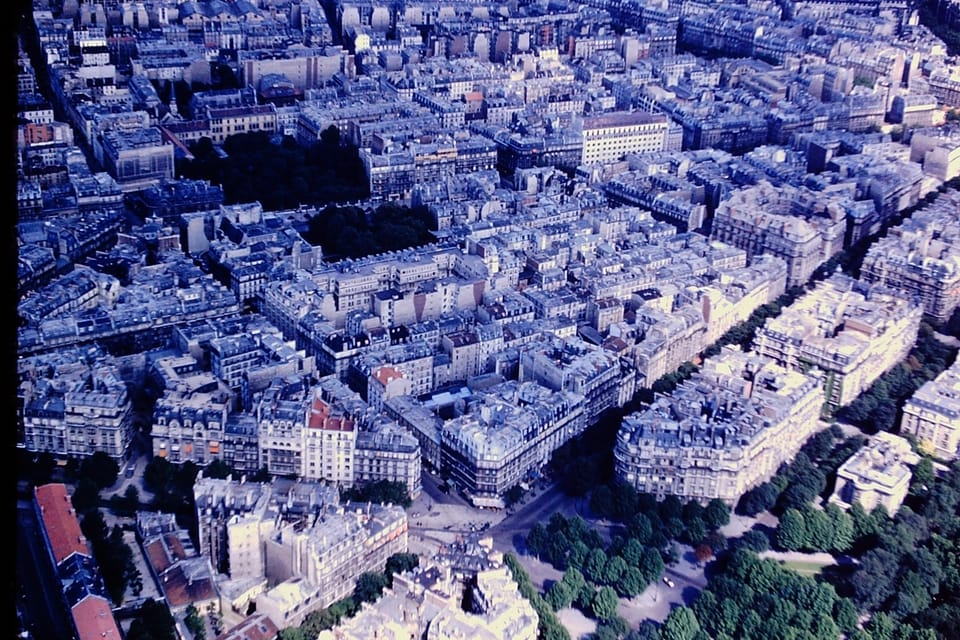
The genius of the French had produced a city brilliantly human in feel, scale, layout, and architecture. From the Eiffel Tower, one looks down on a sea of green tree leaves. Off to one side, the Seine sparkles as barges move slowly along. Here and there through patches of green, one glimpses streets and an occasional building. Easy to spot above the green, are churches. Imagine: a modern, bustling city of millions that resembles a vast city park.
Quaint streets lined with five-story apartments twist and turn as they did a thousand years ago minus only the cobblestones and apartments. Even the streetlights glow a soft, buttery-yellow as if from a dream. Walking one block off main thoroughfares, one hears reassuring sounds of family life: a baby crying, dog barking, birds chirping, people talking and faint street music all about. And the air smells fresh and homey with baking bread and cooking. How fortunate to be nineteen in Paris with money in your pocket and doing as you please.
I compared Paris to New York, our premier city. NY seems a dehumanizing rock pile of phallic-like buildings: each challenging the other with the boast, "mine is taller than yours." All ego, greed, energy, concrete and steel, NY reduces man to a mean existence. Paris, on the other hand, blends human creations with God's in ways that elevate and refresh our spirit.
At the end of our stay in Paris, no one in our section, so far as we knew, had gotten in trouble. Lt. Macklin met us at the hotel and passed out train tickets. Where was Thirsty? No one seemed to know. The magic faded as we entered the train for Hamburg.
Back on shipboard next day, our watch section was told to report to the fantail at 0900 in working clothes. There, we were formed in two ranks and called to attention by midshipman 1st Class Edwards who inspected us. Finishing, Mr. Edwards brought us to parade rest. We stood like that for about twenty minutes.
Then, Thirsty stormed up, his face contorted and red. Calling us to attention, he yelled, "Which one of you son-of-a-bitches did it? If you don't tell me, I'll cancel liberty for the rest of the cruise." No one said a word.
He went down the ranks, nose to nose with each man, demanding, "Did you do it? Do you know who did?"
Each one answered, "No sir," to both questions.
... I thought, "What's happened...what's he talking about?"
After questioning the last man and not getting a "yes", Thirsty shouted, "Liberty is cancelled until further notice. Now go to your cleaning stations. Dismissed!"
Over the next several days in port, we polished brass, holystoned the deck and chipped, scraped, painted and speculated. Then, bits of the story began leaking out.
It seems that someone in our watch section at the Hotel Duville had put a lipstick into Thirsty's jacket pocket. (According to rumor, that's what he told his wife when she discovered the lipstick.) They had a terrible row. Was Thirsty innocent or had he been caught messing around? If Thirsty wasn't lying, who among us was brave or crazy enough to take such a risk? No one knew.
What we did understand was that a schoolboy prank had turned a petty tyrant into a joke—still dangerous, but no longer feared.
Sixteen days later, we had crossed the Atlantic and were back at the Norfolk Naval Base. Waiting to disembark, Al and Jimmy and Kevin told me goodbye. (Our NROTC midshipmen would return to their homes for vacation before the fall semester. The rest of us would get off at Annapolis.)
Kevin turned to me, smiled and said, "I got that sorry bastard but good. Didn't I, Cal?"
"Where did you get the lipstick?"
"Remember those girls we tried to pick up at the train station? Alice and I exchanged keepsakes, her lipstick for my National Defense ribbon."
"But how did you get it in Thirsty's pocket without him knowing?"
"That first day at the hotel, I noticed the side pocket of Thirsty's jacket gapped open when he bent over the counter to register. I slipped the lipstick in. He never felt a thing."
We had a grand laugh. We pounded each other on the back—young men didn't hug in those days—and promised to keep in touch. But we didn't. I never saw my friends again.
Member discussion