South Highland Grammar School
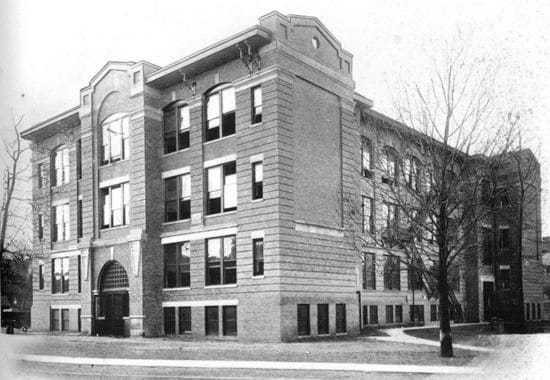
Like a fortress, South Highland squatted on the Southside in the foothills of Red Mountain in the urban community of Five Points six miles south of Birmingham, Alabama. The school was a square, massive stone and brick structure of three stories accommodating some 400+ students. My guess is that it was constructed about 1910/1915.
I recall my first day in September 1940 as being overwhelming. Kids everywhere hung on to mom or dad. Teachers organized us into groups and walked us to classrooms. Parents observed from the back as Gertrude M. Knab seated my group alphabetically.
She established her authority by telling the parents they should leave. Then followed a reciting of her rules: no talking unless called upon; if you need to go to the bathroom, raise your hand and ask to be excused and do not leave your seat without permission.
Ms. Knab was a large, heavyset woman with white hair tied behind in a bun and a round face that seldom smiled. Small, close-set eyes peered through steel-rimmed glasses and missed nothing. She had a sharp, no-nonsense voice that scared me.
Our days began with the Pledge of Allegiance followed by Ms. Knab reading from the Bible, usually, but not always, the Old Testament. She commanded attention by cracking a wooden ruler against her desk, from which she seldom moved. And when she did get up, she resembled a ship leaving the dock, slow and ponderous and deliberate. We were her puppets and we would do as she wished and quickly. Any child that cried went to the cloakroom to cry alone.
Ruling by fear and intimidation, Gertrude Knab was unforgettable. I had never before met a mean adult. I can still hear her saying, "Calhoun, sit up, pay attention. You're daydreaming again." She terrorized me through the first grade. The only time I recall her voice softening and becoming animated was when she read, "The Secret Garden."
Second grade came and I lucked out with Ms B. Josselyn. After Ms Knab, she seemed an angel. I no longer hated school. My report card reflected a grade of Satisfactory in Conduct, Arithmetic, Language and Reading. I got an E for excellent in Spelling and Penmanship. Under remarks, Ms Josselyn wrote, "Oct. 1941-Calhoun holds his book too close to his face. A fine pupil and a joy to teach. Thank you for your help. Jan. 1942 Calhoun needs help with subtraction."
These old, yellowed and smudged report cards differ from those in use today. Then, grades ranged from E-Excellent (90-100), S-Satisfactory (75-90), P-Poor (65-75), F-Failure (Below 65). These marks were assigned in Conduct, Arithmetic, Art, Auditorium, Civics, History, Home Economics, Language, Library, Literature, Manual Training, Music, Physical Training, Physiology-Hygiene, Reading, Science, Spelling and Writing. Comparing my 1948 eight-grade report to my mother's 1926 report card from South Highland, shows that she was a much better student than I. She received all E's except one S in Auditorium. I received mostly S's.
My teachers at South Highland were women, unmarried and between fifty and 70 years old. Several had taught my mother in the 1920's. Most lived in one of two apartment buildings close to school. They walked or used public transportation in getting about.
Reflecting back, my teachers seemed to be on a mission. Their approach to education was very much a product of their time. They were professionals who took their jobs seriously. They would have laughed at today's worries over a child's self-esteem or socialization. They believed that what they imparted would be the extent of our schooling and we would need as much as we could absorb. Understanding that in the 1940's less than five percent of the population had a college degree, their assumption made sense.
They taught by rote, drilling us endlessly in arithmetic, spelling, facts and dates. When not drilling, we were tested, usually at the blackboard in front of the class. One learned who were the bright kids. Those who didn't master the work repeated the grade or went to summer school. Staying after school was the usual punishment for misbehavior.
We were taught to recognize words by sight rather than sounding them out phonetically. This was a new method and, in my opinion, failed. Our ears were never trained to recognize verbal sounds. Spelling depended upon memory. We had difficulty pronouncing much less spelling unfamiliar words.
To this day, I remain a poor speller. (In the nineteen seventies when my sons were attending grade school, Frances and I taught them phonics. They read and wrote better than most of their contemporaries.)
In the mornings before the bell called us to class, the boys played marbles, mumblie peg or spin-the-top. Usually, the girls would be standing about talking.
During recess in grades one - three, dodge ball was the favorite game played together by boys and girls.
In grades four and up, boys and girls separated. Boys played baseball. Girls played hopscotch, jump rope, Simon sez, dodge ball or sat and talked. After recess, the early grades napped with their heads lowered on desks.
In the seventh and eighth grades being selected as a hall monitor or as a crossing guard was a big honor that we competed for. Hall monitors sat at small tables located at each end of the halls. They reported any stranger entering the building or student wandering about.
Crossing guards were identified by white, cloth Sam Browne belts. I prized my belt.
Before and after school, crossing guards controlled the traffic at each intersection by the school. Equipped with long poles having stop signs on one end, cars would be halted so students could cross safely.
For most of my grade school years, 1940 - 1948, the nation was involved in a two-ocean war to the death.
Skillful propaganda created self-righteous anger, demanded that we sacrifice for the war effort and reminded us daily to pray for our boys over there. Most of my classmates had fathers, uncles, older brothers and cousins serving their country. We wanted to help and that meant minding adults.
Our heroes were generals, admirals, soldiers, sailors, marines and airmen. World War II was the most significant happening in the world and we felt ignored on the sidelines. Somehow our teachers and parents seemed to hold us back. I resented being discounted because of my age.
Thinking back, my grade school and Ramsey Hi/8 days prepared me well for college and life. I came away from South Highland understanding the value of discipline and perseverance. Also, I learned that I had to know where I was going if I wanted to get there.
Member discussion