A Little Respect
It was my turn. I sat down, leaned forward and snuggled around the stock. That’s when I first smelled gun oil on a hot barrel: distinctive and pungent, a smell like no other. Eighteen yards away, a turkey’s head would pop up from behind a log and jerk back and forth erratically before disappearing. Visible for fractions of a second and never still, the chances of a killing shot with a 22 were slight. But I was determined; a lot rode on this shot.
Again the turkey raised his head; I lined up the sights, holding my breath; my finger pressed the trigger. The turkey ducked. I relaxed, took my finger off the trigger and waited. Two more times this happened. The turkey’s head would appear, I would aim carefully but the head would vanish before I shot. I put on the safety and stood up away from the gun. I remembered Al Pat’s advice about relaxing and not getting in a rush.
“What’s the matter, boy? 22’s don’t kick! It won’t hurt you. Come on, take a shot,” laughed Uncle Jim Erwin in his deep baritone, broadcasting my indecision to the next county.
I got angry. I said, “I’m going to shoot but I need to stretch!”
The time was Sunday afternoon November 17, 1940 just four days before Thanksgiving. We had gathered at Grandfather Samuel Oscar (SO to everyone) Johnson’s home off Dolly Ridge Road 28 miles south and over Shades Mountain near Birmingham. In the 1920’s, SO purchased 30 acres of mountainside in the country and built his home there. Going to his house was a weekly adventure traveling over dirt roads deep into the woods away from the city. (Now, sixty years later, the old home place is surrounded by many homes and the dirt road by the Water Works has become a busy four-lane highway.)
Usually, the cousins—Bob Miller (8yrs), Glenda Miller (6 yrs), Millie Erwin (6 yrs) and me (6 yrs)—played dodgeball, softball, and hide-go-seek in the front yard while our fathers and mothers visited. On this particular Sunday, Bob and I hung around the men listening to their conversation. For weeks, everyone had been discussing the Battle of Britain, wondering if the Brits would surrender like the French.
“I don’t care what you say. It’s not right to shoot down unarmed planes marked with the Red Cross,” said Uncle Claude Suttle. An insecure and angry man, he could erupt over the slightest difference of opinion. Uncle Claude was responding to Dad’s earlier comment that the British were justified in shooting down German Sea Rescue Service planes operating over the English Channel on the basis that every pilot the Germans saved could fly again to bomb England.
Uncle Jim Erwin yawned, sipped his ice tea and said, “I’m glad it’s not our war. I don’t want us involved; but if we’re not careful, we’ll get sucked in.” Relaxed, good-natured and a tease, Uncle Jim was the polar opposite of Uncle Claude. Dogs and cats kept well away from him but they were attracted to Uncle Jim.
“It’s probably German propaganda anyway,” put in my Dad hoping to calm Uncle Claude.
My Dad and Uncles were discussing a recent news report that the British had been shooting down German planes engaged in plucking shot-down pilots from the English Channel. Of course, the Germans were outraged because their planes were unarmed and clearly marked with large Red Crosses on a white field on their wings and tail surfaces. The Brits countered that the Geneva Convention was silent on this point, and therefore, they were within their rights. I understood most of what they talked about and I knew they were worried. Later, I asked Dad or Grandfather Calhoun to explain what I didn’t understand.
Grandfather SO said, “I don’t like this war talk. It’s Sunday and too pretty a day for that. Let’s have a turkey shoot and see if you guys can hit the side of a barn.” Like his son, my Dad, SO didn’t like family arguments; and besides, he thought of himself as a doer not a talker. He went to the house to get his gun and some shells.
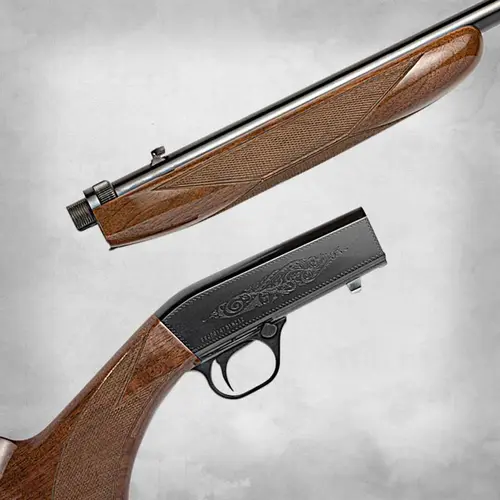
He returned with a Remington Model 24 self-loading, 22-caliber rifle. It loaded through a tube in the butt stock and ejected the fired brass out the bottom of the receiver. Although designed/and produced in the early nineteen hundreds, the Model 24 is a trim, racy-looking rifle, even today. This was the first time I had seen, much less held, a real gun; and I was impressed with its blued steel and walnut stock. Right off, I longed to shoot it.
Carrying his rifle, SO marched into a clearing behind the house. The rest trailed along behind. He stopped at his chicken coop, captured a turkey that he had raised and carried it by the legs down to the horse barn. The barn was about 120 yards from the house and 50 feet lower in elevation. Using a stout string and allowing two feet of slack, he tied the turkey by one leg to a stake between two large logs lying parallel about eighteen inches apart. Backing off twenty paces, he established the firing line.
“OK, each takes a turn until someone hits the turkey,” explained SO. From a standing position, Uncle Jim, Dad and Uncle Claude shot and missed. Turkeys never keep their heads still; so, to hit this small, bobbing and
moving target was a challenge. Each man took a turn and fired five times without scoring.
“I’ll bet I could hit that old turkey…why don’t you give me a chance,” demanded Cousin Bob.
I chimed in, “Yes! I want to shoot.
Uncle Jim rolled up his jacket, laid it on the old picnic table, and placed the rifle across the coat. Bob sat on the bench and fired several times without hitting the turkey. The men laughed and teased him. The idea of a small boy doing what they couldn’t was unthinkable. But I knew something they didn’t.
Even though I had never shot a real gun, I believed I had a chance. All that summer, I had shot my friend and neighbor, Tommy McGowan’s, BB gun hundreds of times. Tommy’s older brother, Al Pat, was an Eagle Scout with a merit badge in shooting. He taught Tommy and me the basics of sight alignment, trigger squeeze and breath control. Day after day during the long hot summer, We practiced shooting clothespins off his mother’s clothesline. Either, she didn’t know or care about our target shooting.
Resuming my place behind the rifle, I knew what I had to do. I waited. The turkey inched his head up and looked around. I moved until the front bead was just under his head and centered in the rear vee. I took a breath, let out some air, closed my left eye and began squeezing the trigger.
The rifle fired and jumped back, surprising me. 52 grains of lead traveled true. The turkey flapped violently and was still. Dianna, Goddess of the Hunt, smiled and so another rifle crank was born that day.
Cynics might say it was a fluke. They’re probably right, but try telling that to youngster.
Examining the turkey, SO said, “I can’t believe it. Look, he shot him through the eye.”
“Boy, how in the world did you learn to shoot like that?” asked Uncle Jim, shaking his head. Dad and Uncle Claude stood by dumbfounded. Perhaps, they wondered as well.
I looked down, kicked the ground and said, “Just luck, I guess.”
For the rest of the day, the men treated me differently. They seemed genuinely mystified that I had killed the turkey. They couldn’t believe what they had observed.
Through the years, SO retold the story of my amazing shot many times. Each time I was filled with affection for him and his rifle. Forty-eight years later, and just before dying, SO gave me his .22. Neglect and time had taken their toll. All the blue was worn off and the stock was dented and dinged with little finish remaining.
I had it restored and now the old veteran enjoys his retirement in my gun safe. When I hold it, I’m reminded of that special day when I earned a little respect.
Member discussion