Uncle Will
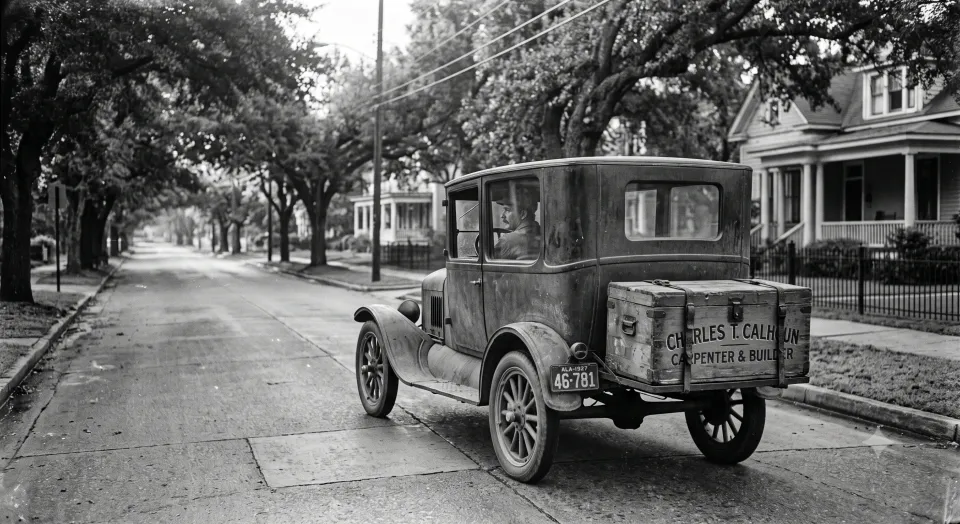
At the dawn of my conscious memory in 1937, I was three, and Uncle Will (Charles T. Calhoun) came to live with us. Actually, he was my great uncle, the younger brother of my grandfather. After a lifetime working as a carpenter, Uncle Will was ill and unable to live alone. He arrived in a tired, old Model T Ford with a small cardboard suitcase and a large carpenter's tool chest strapped on his car. He was 63 years old.
Being very young, I don't remember if taking him in caused a problem. I recall nothing that would suggest the family resented his presence. Blood is thick in Scotch-Irish clans.
Uncle Will enjoyed sitting and napping in a rocking chair on the front porch. Part of family folklore is that one day he removed his false teeth and laid them in his lap. Soon he fell asleep. I was playing on the floor with a toy iron car. Our house sat stair-step fashion on the side of a rather steep hill. Seventeen concrete steps led up to the porch, so I imagine he was tired.
As little boys will act without thinking, I pushed my car off the porch. It bounced down the steps, breaking into pieces. I cried loudly, and Uncle Will lunged out of his chair. His teeth were ejected up and out in a lazy arc that ended against the hard steps, shattering into bits. Hearing my cry, grandmother came running. She found Uncle Will holding me and staring down at the remains of my car and his teeth. Hearing what had happened, she tried to console him about the loss of his teeth while trying to suppress a smile.
He said, "Mamie, it's nothing. The damn teeth hurt me anyway."
As time passed, Uncle Will and I became inseparable. He used to take me for long, "let's pretend" drives through Texas, Louisiana, and Mississippi, revisiting sites where he had built houses.
"Where are we going today, Uncle Will?"
"Let's see. How about Shreveport—you drive."
Uncle Will always let me "drive," sitting in his lap, of course. Grabbing hold of the big wooden steering wheel, away we'd go. He would give me driving lessons by saying things like, "Fella, press the brake and gas gently as if there was an egg between your foot and the pedal. Drive smoothly so as not to upset your passengers or even another motorist."
Along the way, Uncle Will would sometimes talk about our great southern generals from The War Between the States: Generals Lee, Stonewall Jackson, Nathan Bedford Forrest, and J.E.B. Stuart. His stories of battles thrilled me. What a pantheon of heroes the South had in those days.
Arriving at Shreveport, we would eat our sack lunch and talk about the city and the houses he had built there. After several hours, it would be time to head back home. Uncle Will would suggest that we should clean the windshield and lights and recover our car with a tarpaulin. Sometimes, Uncle Will would talk about other cars he had owned, usually purchased second or third hand. Each vehicle had a woman's name and a unique personality. Sadie, a former love, liked to be pampered or she wouldn't start. Doris was expensive, requiring frequent repairs. Genny was by far his favorite because she was reliable and "ran like a sewing machine."
Genny was a Model "T" that brought him to our house. Uncle claimed she was the very best automobile he had ever owned. How he loved her. Retired now, Genny sat on blocks behind our house. Genny took us many imaginary miles and introduced me to exciting adventures as told by my special Uncle.
Uncle Will usually carried rock candy in his pockets along with chewing tobacco, a few coins, some marbles, a long piece of string, and a pocketknife. He shared whatever he had. Today, I realize that babysitting a little boy is exhausting. Yet, Uncle Will never complained or shooed me away. He seemed to enjoy my presence. I know that I loved him dearly, but that didn't prevent me from playing tricks on him.
One warm and lazy summer afternoon in 1937, I was 3, Uncle Will was napping longer than usual. I wanted to play. Grandmother said, "Don't wake Uncle Will. You must be patient. He'll get up shortly and then you can play."
Being impatient, I took a box of Morton Salt, "When It Rains, It Pours," off the kitchen table and slipped into his room. Uncle Will lay on his back with his mouth open and snoring. I dumped some salt in his mouth. He jumped up sputtering and spitting out salt. I took off running with him in hot pursuit. He chased me into the kitchen, where I found refuge behind grandmother, yelling "Save me! Save me!"
When mother returned home and heard what happened, she grew angry. I knew I was in trouble. She got a long, limber switch from our hedge out back.
"Take your pants down, young man. You're going to get it. That was a mean and hateful thing you did."
Uncle Will stepped between us and said, "Now, Evelyn. Please. We were playing. He didn't mean any harm. He was just being a boy."
This made mother madder still. She said, "Fella - go to your room and don't come out until supper."
As I ran off, I could hear her saying to Uncle Will, "How can I discipline Fella when you're always taking up for him, no matter what he does. You're just ruining him."
Later that day, I told Uncle Will I was sorry. He said, "That's Okay. Forget it. We're still buddies." We hugged each other tight. I never played another trick on him. Every child should have a special Uncle.
Uncle Will gave me my first lesson in true and lasting friendship: acceptance and forgiveness no matter the injury. Also, he had a simple life philosophy, explained as "Don't piss into the wind." I understood that to mean, never do what you know you shouldn't.
Uncle Will died after about a year from pneumonia, I think. Years were to pass before I understood how much I missed him.
Member discussion