Home
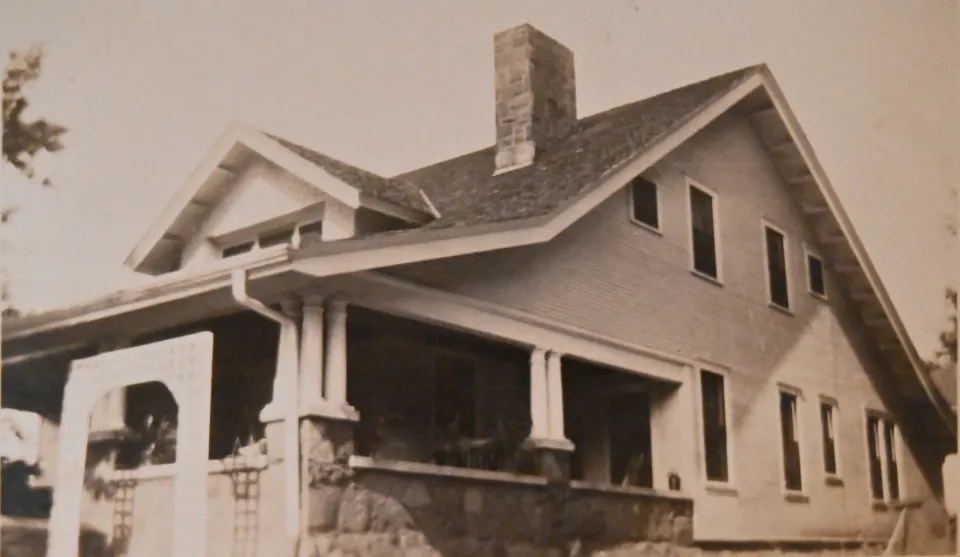
To me, the word home implies a warm, comfortable and safe place to enjoy family and friends. I was born in a house whose address was 1517 South 17th Street Birmingham, Alabama. This was my refuge, my castle and my Camelot for the first 18 years of my life (1934—1952). Constructed mostly of wood, my house was built in the early nineteen hundreds (1910?) on approximately 1 acre. However, only ¼ was flat and the remainder more or less vertical. Like other homes on the southside, my house was placed stair-step fashion up a mountain side.
The site was on the North-facing slope of Red Mountain about 200 feet below the summit. Vulcan, Birmingham’s famous Iron Man statue, stood tall on the mountain top just a handshake from my old backyard. Red Mountain forms the southern boundary of Jones valley. About six miles wide, the valley extends sixty-five miles in an east-west direction in Jefferson County, Alabama.
My house was known as a Craftsman bungalow. This style is credited to two brothers named Charles and Henry Greene, who practiced in Pasadena, California, from 1893 to 1914. They designed simple and flexible structures for working people. As the 19th turned into the 20th century, their designs were popular all over the country.
Our house was a subset of the Craftsman known as a side-gabled roof with a centered dormer. A full front porch nestled under the main roof. There was a break in the roof’s slope on the front and backsides to accommodate the second story. The rooms were outsized, even for those times. Measuring 15 feet by 20 feet, the bedrooms were described as bed-sitting rooms. I believe that the builder scaled up the room dimensions from the plans for a smaller house. This was a common practice and a feature of the Craftsman design. There was over five thousand square feet of heated area.
The house faced west. Each room is etched into my mind as if by some strong chemical reaction. The front door opened to a large living room with twelve-foot ceilings. A fireplace occupied the south corner. This room extended across the front of the house. A forty-foot hallway divided the house down the center from the living room to the back porch.
On the hall’s south side, there were a front bedroom, a bathroom and a rear bedroom. On the north side were the dining room, stairs to the second floor, basement door and the large kitchen. Upstairs were two large bedrooms and one small bedroom converted out of attic space. There was one bath upstairs.
Grandfather (Emmett Rodwell Calhoun or Pawdee to me) occupied the downstairs, front bedroom. Entering his room from the hallway, one saw a smallish metal bed against the east wall centered between two doorways. The right door led to the bathroom while the left door opened into a walk-in closet. On the south, exterior wall, was an impressive roll-top desk with a window on each side. Above the desk, hung a framed copy of the US Constitution. Immediately in front of the desk was a rocking chair. Pawdee rocked back and forth quietly in that chair for years, smoking his pipe, and listening to the news over a Philco radio. On the west wall was a fireplace with a picture of George Washington over the mantel. To the immediate right in a recessed part of the wall was a large safe and filing cabinet. On the north wall was the entrance door off the hallway and a chiffonier. Placed in front of the chiffonier was a Morris chair with an adjustable back and lion heads on the ends of the arms. I enjoyed this room with the ever-present odor of Granger tobacco. As a child, I liked to be near Pawdee. We would talk and listen to the latest war news on the radio. He would patiently explain parts of the news I didn't understand.
Grandmother’s (Mary Lee Blake Calhoun) room was upstairs and at the head of the stairs. The layout was similar to Pawdee’s room: a fireplace, double bed, sewing machine, writing desk and two chairs. On a typical winter’s morning, I would leave my attic bedroom, slip down the hall past Mom and Dad’s room, and enter Nanny’s bedroom. I would light a fire in the fireplace and crawl in bed with her.
As the room warmed up, she told me stories about her childhood growing up on a farm in Carrollton, Alabama. Her father, who had been a doctor in the Confederate Army, lost his South Carolina farm to taxes during reconstruction. The family trekked by covered wagon from South Carolina to Alabama in 1867 where she was born. In the South, those times were bleak.
From my upstairs bedroom, I looked out over the front of the house. This was the bridge of my ship. We visited Mars with Flash Gordon, flew over Africa with Beryl Markham, and occupied a hi-rise in Gotham City with Batman for company. This was a multi–generational house made for high adventure.
The basement was a dungeon. It smelled musty and acrid with coal dust. On the downhill (north) side, the basement floor was about twenty feet under the house. The floor sloped up to a narrow crawl space on the south (uphill) side. The north wall was made of odd shaped rocks cemented together. Located on the second landing leading down into the basement, was a crude storage pantry. Opening the doors revealed rows of Mason jars standing at attention. Each jar was packed with fruit or vegetables canned the summer before. Looking at those jars would cause my mouth to water. I would think about the virtues of being frugal. After my grandmother died in 1946, the family stopped canning and those tantalizing glass Mason jars gradually disappeared. Even today,I miss the taste of the preserves contained in those mason jars with sealing waxed lids.
I built a still on the second landing in 1947. Somehow or another I came across a recipe for making apple cider. Without telling anyone, I purchased a five gallon, glass bottle with a narrow neck about one inch in diameter and a rubber stopper and a length of glass tubing about soda straw size. I put two gallons of apple juice and the appropriate amount of sugar into my still. Within two days, bubbles began to appear coming out of the glass tube and bubbling to the surface of a glass of water. After six weeks as promised by my recipe, my apple cider was ready.
Mother hadn’t noticed my project. One day, I presented her with an eight-ounce tumbler and asked her opinion. She took a swallow, coughed, and that ended my venture. Grandfathers Calhoun and Johnson praised my homebrew as did Dad and Uncle Arnold. Mother put her foot down. The more they laughed the angrier she got. They didn’t share her concern.
On the basement floor and off to the left when facing north was a massive furnace. Round ducts stuck out of the top and snaked up and away to deliver warm air to various rooms of the house. The furnace had a voracious appetite for soft coal. An Iron Fireman fed the furnace from a coal hopper that was filled daily during the winter. An electric-powered worm drive delivered the coal from the hopper through a metal tube to the furnace. I can hear the coal rattling down the delivery tube to this day.
To service the furnace, the drill was to fill the coal hopper, add water to the three humidifying tanks,placed in front and on each side of the furnace. Working steadly,I could finish in twenty to thirty minutes. This was one of my jobs from about the age of eight until I left home for college in 1952.
I have so many fond memories of my house that I will touch on just a few. This one happened on a bright fall Saturday morning. The sun’s rays streamed in through the dining room windows and fell in long shafts across the living room. The air was crisp and coolish. Mother and Aunt Missy were bustling about with energy and purpose. The True Tone radio was broadcasting the sentimental song, “White Cliffs of Dover.” The time was 1940 during the height of the Battle of Britain.
I was coloring in a picture book at the dining room table. I happened to look up and see my mother walking towards me from the living room. A shaft of sunlight held her. Her red hair flamed and sparkled. She was smiling. She walked over, bent down and kissed my cheek before passing into the kitchen. Not a word was spoken, but I knew in my bones that this beautiful and vibrant woman loved me unconditionally. I felt very special.
I spent many tranquil fall afternoons playing on the front steps with my dog Fluffy. We would talk and watch trails of smoke from burning leaves drift up slowly and disappear into the trees. Burning leaves smell marvelous and announce the coming of winter. Uncle Arnold Brauniger had given me Fluffy in 1940. He was a three-week-old puppy. From then until he died fourteen years later, we were best friends. We went everywhere together. He taught me the nobility of loyalty and trust.
During WWII on cold winter days, I would stop playing with my friends at the bottom of the hill on 15th Avenue and look up at my house. I knew it would be warm and cozy and waiting for me when I got tired and hungry. I felt great affection for it.
In the springtime, the rains came for days on end or so it seemed. When I could stand being indoor no longer, I would put on rain gear, grab my rifle (wooden toy replica of a Springfield 30-06) and fight the Japs on Guadalcanal.
Weekly, the traveling vegetable truck would arrive. An old colored man would sing out in a beautiful baritone, “Fresh strawberries...fresh...Melons ripe melons...ripe...Get your corn and string beans...corn and beans...” Mother or Aunt Missy or grandmother or all three would hurry out, look over the produce, and make their purchases. As if on cue, a young black man peddling a three wheel ice cream cycle would show up ringing his bell. I would buy a five-cent Popsicle and wander into the back yard to lie down on the grass and enjoy my ice cream. The ground would feel soft and cool and smell clean and fresh. Looking up into the trees, I thought of them as friends, standing tall, with their arms outstretched to shade me. Soon, I would imagine myself sitting among the branches with the birds.
On Sundays during the summer, the family would gather around a long table on the back porch to eat lunch. It was cooler there away from the heat of the kitchen. We would enjoy heavy meals of fried chicken with mashed potatoes, string beans, fried okra, squash, carrots and, best of all, lemon ice box pie. We would wash it down with ice-cold tea or milk. Even I didn't mind napping after those delicious meals.
Napping was important then. Polio was the medical scourge of that day, much as AIDS is in the two thousands. People were terrified of this often deadly, usually crippling disease. Doctors warned parents to keep their children away from crowds; never use public swimming facilities. Also, they recommended against getting overly tired and suggested summertime naps.
On lazy summer afternoons after my nap, I liked to sit in my mother’s bedroom. Just outside her window on the second floor, a large sweet gum tree branched out. I thought of this as my tree house. I enjoyed looking north through the leaves and across the valley to Ramsay High School. Ramsay sat on top of the next hill about three blocks away. There was usually a cool breeze that brought in the oily smell of hot roofing mixed with the sweetish odor of flowering gardenias. I longed to attend Ramsay. Going to high school would signify that I was leaving childhood. That milestone was important to me even at eight years old.
Summer evenings on our front porch rank with the best. I would lean back and put my feet on the ledge and watch the sunset over the west end. On some very special days, the skies would be filled with large, billowing, white cumulus clouds rising thousands of feet. Without effort, the setting sun would paint them in marvelous shades of red. I would recall the old saying, “Red sky at night - sailor’s delight. Red sky in the morning, sailor take warning.”
Night would fall ever so gently, not scaring anyone. Insects would tune up for a concert. Conversations would slow down and the pauses get longer. Soon the heavens would be filled with a zillion bright, winking stars. Each one of us would be lost with our private thoughts. And I felt happy. This was truly Camelot.
There have been other houses that were special to me but 1517 South 17th will always be home. I grew up there. My character was formed within those walls. It was a house that knew birth (mine) and death (Uncle Charlie and Uncle Will) and much happiness and excitement and some fear and sadness.
Mom and Dad sold my house in 1962 to build a new home over the mountain in a better location. My home was eventually abandoned and then torn down in 1973 to be replaced by a tacky apartment complex. Memories and shadows from the past are all that remain.
Member discussion