Number 4
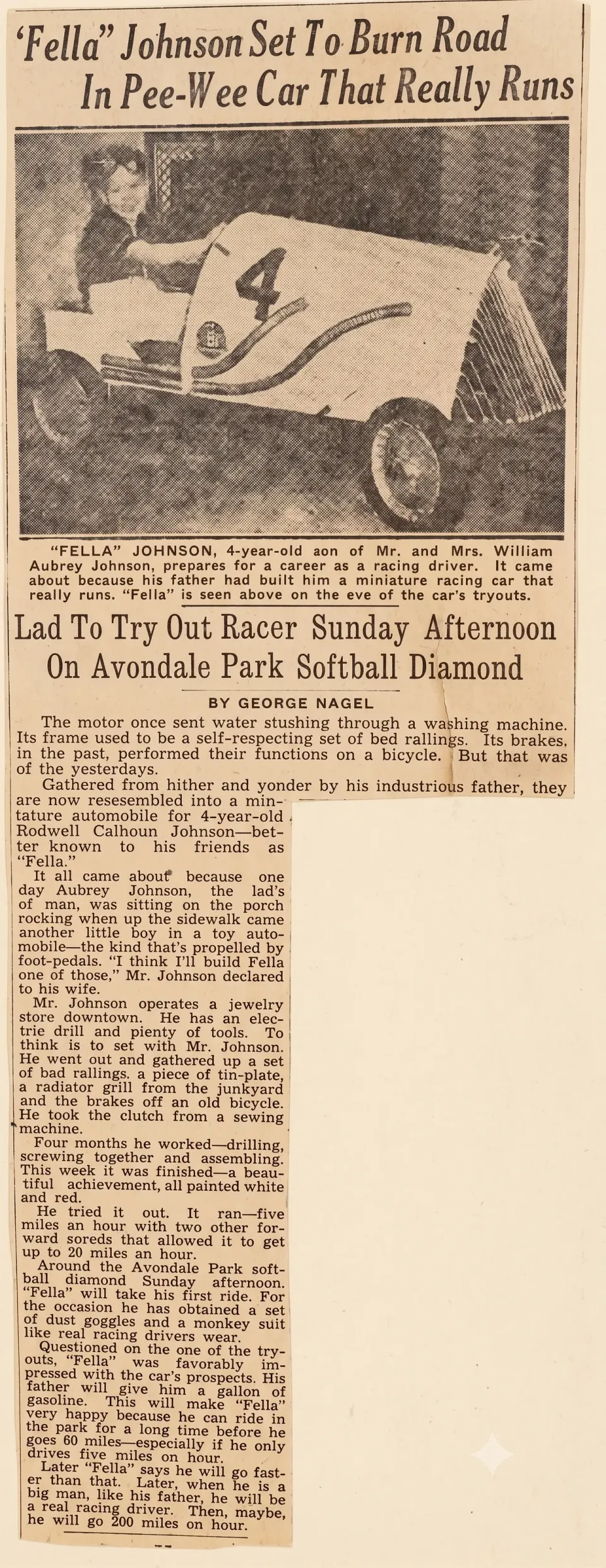
To me dredging up memories from the distant past can be likened to stumbling about a darkened room filled with familiar objects partially hidden by shadows. Yet, meeting them again, my childhood memories are friendly, intimate and real yet altered and fuzzy. Writing about them challenges me. Did it really happen like that? Who knows and cares? I do.
One of my earliest memories occurred in 1938 shortly after my fourth birthday. This event was a defining moment for me. You may smile at the notion of a four-year old having a life-changing experience, much less recalling enough to write about it sixty plus years later. But I did and I remember the details.
This story begins in the winter of 1937/1938 when my dad decided that I needed a real racing car for my fourth birthday on May 23. Why this was important to him, he never said.
Dad began by salvaging a one cylinder, two-cycle gasoline engine off a Maytag "country" washing machine. In those days, most rural areas didn't have electricity. If a family wanted a powered washing machine, small gasoline engines provided the power.
He welded together a chassis using metal rails from a bed. The chassis rode on four hand truck wheels attached to solid axles with no springs or shock absorbers. He designed and fabricated the steering mechanism. A bicycle brake on a rear wheel provided stopping power. There was no throttle. Upon starting, the engine ran at a constant speed with power being transmitted through a Singer sewing machine clutch.
Dad built my racer in a balcony work shop in the rear of his father's jewelry store at 1725 2nd Avenue North, Birmingham, Alabama. Many Sunday afternoons through the winter and spring of 1937 and 38, we visited his shop. There he would explain, man-to-man, what he was doing and telling me tales of great automobile races. When I got bored, he taught me how to hammer nails, tighten and loosen nuts from bolts and screw in screws. My hands were small. I practiced many hours before I could handle simple tools.
As the months passed and the racer took shape, my excitement grew. I asked Dad again and again when it would be finished and to show me how to drive. He would caution me to be patient, but he did let me sit in his lap and steer the family car during Sunday outings. I must have been a terrible pest.
Then, four months and five hundred man-hours later, I had a shining, white, open-wheeled racer with number four painted on the side. I thought it was the most beautiful car in the world. The number stood for my age and made it mine.
The initial trial run was in June 1938. Mom, Dad and I trailered Number 4 behind the family's 1935 Ford sedan to Avondale Park in Birmingham. Avondale had an oval, paved track about sixty yards per side and 45 yards at each end for bicyclists and skaters. This was a safe site to test Number 4.
After unloading, Dad added gasoline--a mixture of olive oil and gasoline--and checked the tire pressure. Mother and I stood by watching as he tinkered with the engine. Then, with a hard push down on the crank under the dash, the engine rumbled to life. Blue-black smoke poured out the rakish side exhaust pipes. The sound was a gutsy, low, Harley-Davidson-like series of pulsing bangs.
Dad climbed aboard. I wanted to be first but he said he must test it. I watched. With his legs outside and his feet resting on two metal bars, he roared away and went around and around the track. Satisfied with Number 4's performance and that I understood the controls, he turned it over. Mother stood by,frowned, looking serious. The big moment that I had dreamed about for months arrived. Determined to drive well, I adjusted my goggles, grasped the steering wheel and eased the gear lever down engaging the clutch to apply power. Away I went. At last, I was in control and what a liberating feeling that was.
I darted first left, then right, then left again as I over corrected in the first 100 feet. The steering was rattlesnake quick. That quickness coupled with the rock hard suspension made my racer's handling skittish. We took turn one wide gaining speed. Approaching turn two, I pulled up on the gear lever cutting power and slowing. I applied the brake and cranked the steering wheel right. As soon as I had my machine through the curve and sorted out, I pressed down on the gear level restoring power. We lunged ahead.
Roaring down the straight at max RPMs (I guess about 40 RPM and 5 mph), I saw the crowd (Mom and Dad) cheering and waving. I waved back and pounded on the side for more speed.
In my mind, I was Tazio Nuvolari driving his P-3 Alfa at the 1935 Nurburgring in Germany. I was challenging the mighty Mercedes-Benz and Auto-Union factory teams. Turn one coming up broke my reverie. Time to focus . I cut the power and applied the brake, steering gently. Then, I pressed down hard on the pedal for power, and away we went, trailing a plume of blue smoke. And so it went for twenty laps until my fuel ran out.
The pit crew (Mom and Dad) greeted me with hugs, kisses and congratulations. I was at least six inches taller and fifty pounds heavier. Never before had I felt so full and complete - a man at last, or so I believed.
Leaning over to watch Dad add more fuel, I made a mistake. My bare leg brushed against the hot exhaust pipe. (Race car drivers in those days wore short pants.) A stick of butter from our lunch soothed the pain. Mother gave Dad that angry, a now-see-what-you've-done look.
Since I didn't cry even though my leg hurt like hell, Number 4 was refueled. I jumped in vowing to overtake Bernd Rosemeyer in the leading Auto-Union. Around and around I chased him gaining a few seconds each lap. I was about to pass when my engine sputtered and cut out from lack of fuel.
Yielding to my crew's advice, we quit for the afternoon. As we packed up to leave, I gave an interview to a reporter from the Birmingham News. He took my picture. A few days later, a story appeared in the paper confirming my ride.
Certain events alter our perceptions forever. From then on, we seem to view life through a new lens. My first ride in Number 4 affected me this way. I owe it all to a loving father and mother, caring enough to let me pretend to be a man well before my time.
Postscript 1. Thirty years later in 1968, on leave before shipping out to Vietnam, my wife, two sons and I visited Mom and Dad in Birmingham. It was a sad time. Mom, suffering from terminal breast cancer, had been released from hospital to die at home. The only time during this visit that I saw Dad smile was when he retold the story of Number 4 to my sons, Rod (5 yrs) and David (2yrs) as they inspected my old racer.
Postscript 2. Sixty years later in 1998, Frances and I rushed to Birmingham from Houston to attend the estate auction of Dad's home furnishings on Old Brook Trail off Dolly Ridge road in Mountain Brook. My aunt Mildred, Dad's sister, had called the day before with the news that Dad's second wife, Edie, was selling everything. Two months before, she had placed Dad in an assisted living facility. We arrived home to collect a few personal items but not in time to save Number 4 from being sold for $500. After sixty years, my racer was gone. This reminded me again that we are more caretakers than owners of our treasures.
Member discussion