Shipyard Shenanigans and the Caribbean
Some time later, we were back at the Des/Sub piers. The CO had the con - meaning he was the OD (Officer of the Deck) and driving/sailing (take your pick) the ship. Approaching the pier too fast, he didn’t bleed off sufficient momentum (by reversing engines soon enough or long enough). The Conway banged into the wooden pilings protecting the seawall. Over the bridge radio speaker came, “Conway, what are you trying to do, wreck my pier?”
Cdr. Baker grabbed his radio microphone and answered, “No. Just trying to get closer to the club.” He was referring to the Officer’s Club less that a block away from the piers.
“Well, that’s going to cost you. Come see me. This is the port captain. Out.”
Getting the ship tied up and on shore power with fuel, water and power lines attached and telephones hooked up usually took about two hours. Then working parties had to load fresh and frozen provisions and other stores.
Being in port is a supply officer’s busiest time. I spent my days expediting parts, pleading for additional operating funds from DesFlot #4, arranging daily delivery of fresh provisions, dairy products, baked goods and organizing laundry service for the crew, turning in foreign currency, obtaining money to pay the crew, processing endless paperwork that accounted for and made things happen. Of course, I had help. My senior enlisted men were indispensable and they did most of the pick and shovel work. Nevertheless, the responsibility for getting it right remained mine. There were hundreds of details that had to be attended to, monitored and explained or justified to the XO and CO.
Like most Naval Academy midshipmen, I saw myself someday as an Admiral commanding ships and fighting great sea battles. What a come down when red/green color blindness slotted me into the Supply Corps upon graduation. In retrospect, that was the best thing that could have happened. I developed business skills that served me well in civilian industry when I retired from the Navy. Most likely, I would not have made the Navy a career as a line officer.
That first day back in Norfolk, after watch sections had been made up and liberty granted to the crew, Dick Erwine, Ted Dyer and I headed to the Officers Club for dinner. I returned to the ship about 2000. I finished that day’s paperwork and planned the next day’s schedule about 2300. I took a shower and went to bed.
Around 0100, SD2 (Steward Mate 2nd Class) Flowers woke me and said, “Mr. Johnson, the captain is back on board and wants me to make him and his girl friend breakfast. The pantry is locked. I don’t have the keys.”
“Here Flowers, take mine and be sure to bring them back. Don’t forget to lock the pantry when you’ve finished.”
“Yes Sir.” Flowers returned about twenty minutes later with my keys.
Just as I was about to fall asleep, Joe Judge (the in-port duty officer) entered my room—really a small space shared with two other officers and just big enough for two sets of bunk beds and a small basin—and said, “Cal, the Captain has gone to sleep. I can’t wake him. His girlfriend is upset and wants someone to take her home. I can’t leave. You’re the only other officer on board. You’ll have to take her home. Here are the CO’s car keys. Hurry up, she’s becoming a royal pain in the butt.”
“OK. Give me five minutes.”
I found Ms. Joyce Keffer waiting in the wardroom. My first impression wasn’t favorable—mid too late thirties with too much makeup, too much costume jewelry, too much bosom exposed and way too much attitude.
I introduced myself and said that I would take her home. She said, “It’s about time. I’ve got to get home. Some of us have to work, you know. Not like you sailors. Let’s go.”
“Yes ma’am. Let me help you. This way,” I said offering my arm for support.
“I know how to get off your damn boat,” she said pulling away, stumbling and almost falling through the “knee knocker” of the wardroom’s watertight hatch. (Doorways or hatches on Navy ships are oval shaped and raised about thirteen inches off the deck, hence the term, “knee knocker”.) In the background, I heard SD2 Flowers snickering.
As we drove past the gate and off the base, I asked, “Where do you live?”
“I live in Virginia Beach but let’s have a drink first.”
“Ma’am, I’m on duty (a white lie) and I can’t drink; besides, I must return to the ship quickly. Where in Virginia Beach do you live?” She gave me her address and slumped against the passenger door going to sleep. She was no help with specific directions.
It took me almost two hours driving around to find her apartment complex. Waking up she said, “I’m going to be sick.” I just managed to reach across and roll down the window before she made a mess along the side of Cdr. Baker’s car.
Eventually, I got her inside her apartment, found a self-service car wash, cleaned the car and returned to the Conway about 0730.
Reporting on board, Chief Jenkins said, “The CO wants to see you. He’s in his cabin. And Mr. Johnson, be careful what you say.”
“Thanks, Chief.”
Knocking and entering the CO’s cabin, his first words were, “Where the hell have you been? What took so long?” I thought: Oh, shit. He must think I played hanky panky with his girl friend. I took three deep breaths and told him what had happened. Apparently, he believed me. He said, “This is between you and me. You’re not to tell anyone, ever. Do you understand?”
“Yes sir. You have my word.” From that moment until he was relieved some five months later, the CO treated me differently and to my benefit. Afterwards, my shipmates tried on several occasions to discover what had happened that night. I never told them.
For the next three months, our routine followed a familiar pattern. We operated at sea for two to three weeks followed by seven to ten days in port. The only event worth noting was the shot fired in the supply office.
It happened this way. When in port, I usually made one, sometimes two trips to the bank to get money to pay the crew. My disbursing clerk and a storekeeper went with me; we were armed with 45 caliber automatics. (I kept the pistols and ammo locked in the disbursing safe in the supply office.) I was familiar with the 45 and insisted my men know how to load and unload their weapons safely. (They had qualified at the Marine Corp small arms school in Little Creek.)
One day we received word from DesFlot #4 that an attempt had been made to rob a supply officer carrying his ship’s payroll. We were directed that in future an armed marine or gunners mate would accompany any supply officer with a payroll.
The XO insisted that I follow the new policy and I did. I replaced my storekeeper with a gunners mate who, I was assured by the Ops officer, was qualified with the 45.
Upon returning from the next bank run, I told my disbursing clerk and the newly assigned gunners’ mate to unload their weapons. I was still putting money in the safe when I was stunned by the noise from a fired 45 caliber round in the small, all metal supply office. I knew what had happened but I was completely deaf as was my disbursing clerk and gunners’ mate. Thankfully, no one was injured although the bullet ricocheted around the office several times before falling to the deck.
After about a minute our hearing returned and I learned that it was the gunners’ mate whose weapon had fired. He had loaded it in the armory and carried it that day, locked and loaded, with a round in the chamber and the safety on. That was contrary to my policy of carrying the weapon with a loaded magazine but no round in the chamber. (It only takes an instant to jack the slide—pull it back and allow it slam forward loading a round.) What happened was that he removed his magazine, held the weapon at port arms (with the muzzle pointed skywards) and, forgetting the chambered round, pulled the trigger.
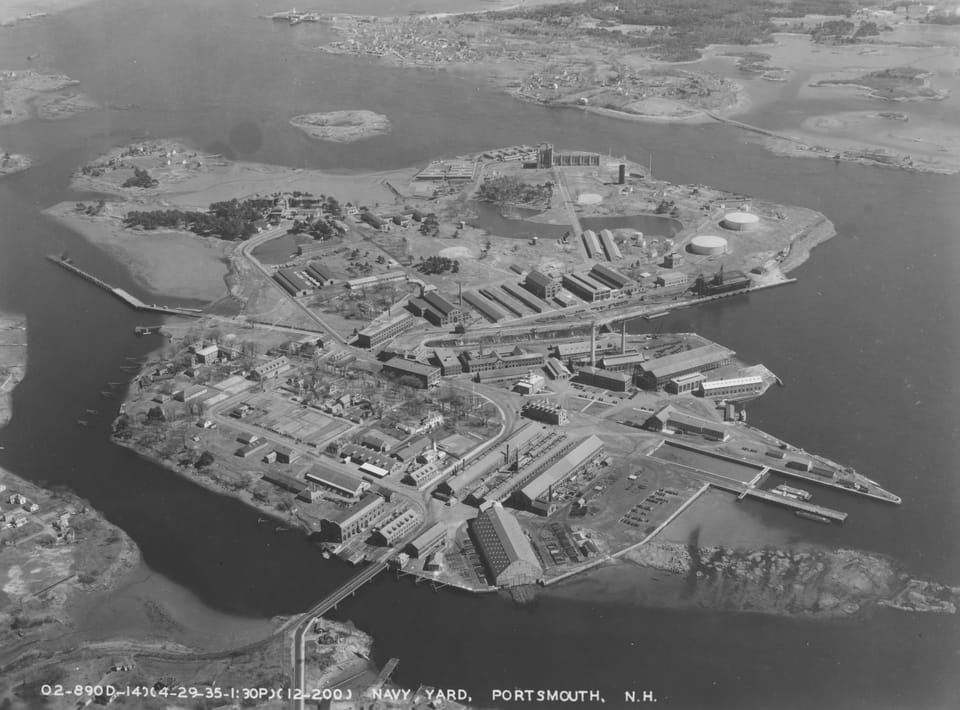
In November 1958, the Conway entered the Portsmouth Naval Shipyard for an extended overhaul. We were getting the very latest sonar as well as improved air and surface search radar. New evaporators, overhauled main generators as well as hundreds of other improvements were scheduled. The supply department would have a new galley, new flooring for the mess deck and a complete restocking of all repair parts. It was to last about seven months and cost in the millions if my memory is correct.
Before we entered the yard, representatives arrived with thousands of 3x5 IBM punch cards in thirty-inch long cardboard holders. Each card had a pattern of small, square, punch holes that when run through a computer would print out on a continuous roll of computer paper each job: how much it cost, how many hours to complete it, start and end dates and any other pertinent information relative to that job. (Cdr. Baker used those print outs to check the status of each job and he nearly drove us crazy with his demands for progress on shipyard jobs we had no control over.)
At this initial meeting, our CO made a bad decision (in my opinion). He announced that the non-married officers and crew would live aboard the ship during the overhaul. The Shipyard Superintendent advised against this saying that it would complicate the work. Not so countered our CO. The men wouldn’t lose work time traveling to and from the ship each day. This was the beginning of a miserable seven months for most of the crew and officers.
We entered dry-dock in mid-November. Sand, dirt and fine brownish dust from sandblasting the hull and superstructure, got in our hair, noses and mouths, and filled every crevice of the ship. The incessant noise from chipping hammers, grinding wheels and banging metal beat us to a pulp. It was a wretched experience. (The only thing most civilians could liken it to is living in a house undergoing major interior/exterior renovation.)
When we finished a long, hard day, we went to the “O” club to watch TV or get drunk. Returning every night to a cramped, dirty and damp stateroom that was either too hot or too cold was depressing. Every one not married and living ashore grew disgusted with our living conditions. Morale hit bottom. Men went AWOL, reported to sickbay in growing numbers, failed to accomplish their jobs, and got in trouble with the law. Reenlistment rates fell below 12%. This shipyard period was turning into a personnel disaster.
I told the XO that we couldn’t maintain cleanliness in the galley and that we should allow the crew to eat in the shipyard galley. We argued. Eventually the CO relented and we ate ashore but still lived aboard.
Three months into the overhaul, Cdr. George R. Bryan, Jr relieved Cdr. Carl S. Baker. A month later, LCDR Sam Sea relieved Lt. Peter A. Stark, Jr. as our new XO. We didn’t notice any changes from our new command.
The only bright moments during the dismal, shipyard months were the occasional tea dances sponsored by senior officer wives at the “O” Clubs. These events brought together young single women (usually nurses and school teachers) and single officers. I remember meeting one attractive young lady who said, “Do all you sailors smell alike?”
“I beg your pardon. What are you referring to,” I asked feeling mortified.
“You know, your clothes smell like fuel oil,” she said smiling.
“I suppose that’s the price we pay for living aboard a Navy ship. I hope my odor isn’t too offensive,” I said with more sarcasm than intended.
“It isn’t—just unusual and distinctive,” she answered. I dated her a few times; but as it turned out, the chemistry wasn’t right. We parted as friends.
Eventually the shipyard period ended and the Conway steamed into Guantánamo Bay, Cuba and tied up at the US Navy’s training facility established there in 1903. Ninety percent of the sailors assigned were new to the Conway; we faced the backbreaking task of training this new crew and forming them into a team. We had only three short weeks.
Each day we steamed out of Guantánamo Bay with training observers on board to grade our exercises. We executed again and again every shipboard evolution or emergency from man-overboard drills, to loss of all shipboard power, to gunnery practice including anti-aircraft firing, shore bombardment, using our Weapon Alpha, and then the old standby from WWll, firing hedgehogs.
A hedgehog missile is about 48 inches in length and looks like a potato masher with a warhead about 7 inches diameter and fifteen inches long where it reduces to a 3-inch diameter hollow tube that ends in a circular tail fin to provide stability in flight. The whole missile weighs about 75 pounds. The missile was not a rocket but was propelled by an impulse charge of smokeless powder.
The hedgehog launcher is a square box with 24 prongs/spigots sticking up. 24 missiles are fitted over these angled vertical rods of the launcher. Missiles are electrically fired in pairs every 0.10 seconds, with the highest trajectories being fired first so that all 24 hit the water about the same time. Our Mark 11 launcher fired a circular pattern measuring about 200 feet in diameter out to a range of about 188 yards. The missiles would sink and explode at a set depth or if near a submarine.
The hedgehog loader was trained to support the warhead in the palm of his left hand and with the tail fin down and held on the palm of his right hand. Thus he would place the missile on its guide rod and allow it to slide in place. This was an awkward process but best from a safety standpoint.
Most untrained men would grab the missile with both hands just below the warhead where it was about broom handle size and fit it onto the guide rod. Loading procedures warned against this practice because should the missile fire while being placed on its guide rod, the tail fin could injure the loader’s hands.
One of my men, SK3 Denton, was a loader on the hedgehog; he was a happy-go-lucky, teenager from the backwoods of Tennessee. The first day we had hedgehog practice, as Denton was loading a missile, it fired, tearing away most of his right hand and all but two fingers on his left hand. The hedgehog battery and the surrounding deck were painted red with Denton’s blood. When it happened, one shipmate held him down while two others tightened belts around each arm to stop the bleeding. “Doc” (Chief Pharmacist Mate) Allen saved his life by immediately transfusing him directly from other sailors. We were out of helo range and it was over an hour before Denton could be airlifted to hospital.
This hellish accident sickened me. How could this have happened, I asked myself over and over. The hedgehog had two separate and independent circuits that had to be armed and a trigger pressed before the hedgehog would fire. And supposedly, there was no way it could have been in firing mode while being loaded.
Yes, there was a formal investigation but no adequate (to my mind) explanation—electrical short circuit was the investigating team’s conclusion—for what had happened. I was a junior, staff officer and so I didn’t carry much weight. To this day, I regret that I didn’t demand better answers from the ASW officer in charge of the hedgehog and the officer heading up the accident investigating team.
On the way back to Norfolk from Guantánamo, Cuba, the Conway was given permission to make port calls at Kingston, Jamaica and Hamilton, Bermuda. In spite of the shock of what had happened to Denton, the crew was looking forward to well deserved shore leave in a foreign port.
We spent two days in Kingston where I witnessed the fading British Empire. The Conway officers were invited to play tennis and golf at the British Club. I couldn’t interest anyone in going with me so I went by myself. I wanted to see a piece of colonial Britain up close.
The club was located a few miles out of Kingston in a beautifully lush, tropical, hillside setting. The grounds appeared to have been manicured; however, the club with its wide verandas was showing definite signs of age. Inside, the furniture was very comfortable but worn. Along one wall there was a series of glass display cabinets with engraved silver tennis, golf and lawn croquet trophies dating to the late 1880’s. There were some three-week-old copies of the London Times. It felt like I was in a time warp. Other than three black waiters and one elderly white lady sitting on the veranda, there was no one else.
I introduced myself to the lady and learned that her name was Ms. Grace Patricia Rutledge—“Just call me Gracie.” She told me that she was born on a sugar plantation in Jamaica in 1883. Her parents had shipped her home to the UK when she was seven to live with relatives and get an education. She returned to Jamaica in 1913 just before WW1, married a planter, and had four children (one boy and three girls). Her husband died in 1954 and she sold their holdings and retired.
Her children and grandchildren lived in the UK and were encouraging her to move there. She hated the cold and would remain in Jamaica. Gracie was a wonderfully gifted storyteller with her lilting but precise and clipped British accent making her sound like a stage actress. Her innate formality, however, was tempered by an impish, down-to-earth sense of humor.
She said, “Young man, you should have seen this club before WWII. We had such fun parties and dances every weekend. Wives and children visited each other’s homes during the week while our husbands worked the fields. It was a wonderful life. Everyone had money. Now, it’s hard for a planter to break even. Most have sold out and moved but I don’t want to leave. Jamaica is my home.”
“Still, it must be lonely. Do you have friends?”
“Yes. Every Wednesday I had lunch here with three friends and then we played bridge. I’ve lost two of them this past year and my only remaining friend, Alice, is sick in hospital. But one must carry on.”
I savored every moment of my conversation with Gracie that afternoon. When I returned to the ship, I felt my visit ashore was well spent. Kingston was a sad monument to abject poverty, ignorance and squalor; it was pitiful.
Ten days later, back in Norfolk, I received orders to Airborne Early Warning Squadron #4, (the Hurricane Hunters) located in Jacksonville, Florida as the supply officer. I told my shipmates goodbye, saluted the quarterdeck and departed with mixed feelings.
I remember thinking I was glad my Conway tour was over. It had been lots more drudgery than adventure and I was wasn’t sure I wanted to make the Navy my career. Also, I just started to feel that the leadership that is discussed is so bad. Real leadership is really about personal integrity and caring for and service to the men you’re leading. Those attributes can’t be faked; they’re either in a person’s soul or not.
Member discussion