USS Conway DDE 507: Sea Stories from 1958/59
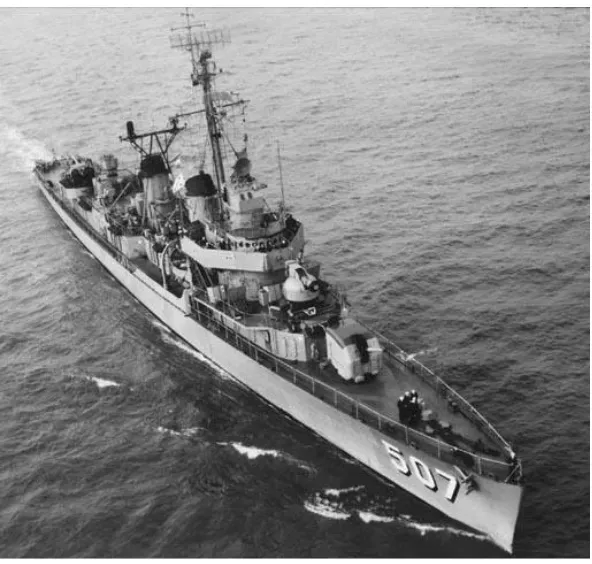
began my career as a naval officer in the traditional manner on a small, blue—water, fighting ship. In May 1958, after four years at the US Naval Academy in Annapolis Maryland and 6 months in the Supply Corp school in Athens, GA), I was one of two officers (Ens. Paul Charette, being the other) temporarily assigned to the staff as replacements should a supply officer vacancy occur on one of the deploying ships.
Reporting to DesFlot #4 [located on the repair ship USS Sierra tied up to a Destroyer/Submarine (Des/Sub) Pier at Norfolk, Virginia], I found myself in the midst of a hurry-up, get-it-done, all-out effort to ready our destroyers for an unplanned, extended deployment to the Middle East. President Eisenhower wanted to show the flag and calm tempers in Lebanon. (Then, no one would have believed that forty-six years later in 2004 U.S. servicemen would still be fighting and dying in that troubled region.)
For the next two weeks Paul and I worked fourteen to sixteen hour days expediting repair parts in the system and from vendors, coordinating delivery of stores, arranging cash and foreign currency pickups from local banks and conducting readiness reviews for the four ships—Conway, Waller, Basche and Beale—in DesFlot #4. I might mention that commanding officers (CO’s) of deploying ships become agitated and irritable at the slightest possibility of having to report a vital system, “not ready for sea.” I know for I was on the receiving end of colorful expletives describing what would happen to my posterior if such an essential part didn’t arrive on time.
Late on the Saturday morning before Monday’s scheduled sailing, Cdr. Flock, received confirmation that all our ships were ready for sea. He relaxed and dismissed the staff for the weekend.
The next day, Sunday, I was enjoying the sun and girl-watching on the officer’s beach at Virginia Beach. As I was about to doze off, the loudspeaker came on with, “Ensign Johnson call the DesFlot #4 duty officer immediately.”
The duty officer told me to pack, check out of the BOQ (Bachelor Officer Quarters) and report to the office as soon as possible. There, Cdr.Flock said that I was to relieve the supply officer (SO) on the USS Conway before the deployment, now less than 18 hours away. (A normal relief of a SO takes about two weeks.) He continued by saying that Ens. Charette was also conducting an emergency relief on the USS Waller.
A chill went down my spine as I thought about the magnitude of what had to be done and how little time remained.
The SO on a destroyer must count the ship’s money (about $80,000) and verify the accuracy of the cashbook. This process usually took five to seven hours. The relieving SO must exercise care because you will be held personally accountable: any shortage will come out of your pay. Then, the SO audits the ship’s operating funds (a check-book balance against Navy appropriations) in the general ledger. As I remember, this audit took between one and three hours.
Next comes a detailed inventory of the ship’s store—personal care items like razor blades, soap, toiletries, candy, clothing, pencils, papers, cigarettes, etc.—because these items are sold to the crew and subject to theft. At sea, the ship’s store is open about one hour per day. In those days (1958), the inventory plus cash on hand was valued at about $35,000. That’s a lot of nickel and dime items stowed in an eighteen-foot, odd shaped compartment in the stern with barely enough room to sit upright. Working steadily and assisted by the storekeeper in charge, an inventory took between six and twelve hours. That assumes no discrepancies between the actual line-item count, the records and the cash on hand. Once completed, the SO becomes monetarily responsible for the total value of goods and cash. Any shortage between the cash on hand and the inventory value comes out of your pay.
After that, the commissary stores—fresh, frozen and canned goods—are inventoried and verified against records of purchase, delivery and what has been consumed in the general mess (the mess hall). Like the ship store items, the SO assumes accountability for the dollar value of the inventory. I wasn’t as worried about this count because minor discrepancies can be written off as consumed by the crew.
Working around the clock, and assuming no significant problem, Cdr. Flock figured that I had just enough time before sailing (18 hours beginning at 2:00 p.m. that afternoon and finishing the next morning by 8:00 a.m.) to certify my fiduciary responsibility to the Conway’s CO. This takes the form of a signed report noting any discrepancies and officially relieving the former SO.
I asked, “Commander, what happened to Ensign Morris, the Conway’s SO, and the SO on the Waller?”
“I’ll let your new CO or XO tell you.”
Off we went—Cdr. Flock, chief petty officer (CPO) Cameron and me—to pier four where the Conway, Waller, Basche and Beale were nested together by twos on each side of the pier.
Upon seeing the Conway, my first impression was that she appeared tired and on life support with fuel and water hoses and power cables draped across the deck. She looked more like a tired, but still menacing, bulldog than a sleek greyhound of the sea. Fifteen sailors were moving up and down the gangway loading stores from a pier-side delivery truck.
At the DesFlot #4 office, I had read the ship’s biography and knew that the Conway was named for William Conway, a signal quartermaster serving on the USS Mississippi during the Civil War under Admiral Dewey. The Bath Iron Works in Bath Maine built the USS Conway (DD507) and launched her on 6 August 1942.The Conway served throughout WWII, receiving thirteen battle stars for duty in the Pacific. She assisted in 32 landing bombardments, was credited with 9 downed enemy aircraft, and assisted in sinking two enemy destroyers and one transport. Reading her battle citations, I realized that this ship had a distinguished past and now it was my turn to share her destiny.
The Conway was 376 ft, 6 in from stem to stern. She displaced 2050 tons and had a draft of 17 ft, 9 in. During wartime, the crew numbered 310 men but her current (1958) complement was 165 men and 7 officers.
Waiting on the dock to go aboard, I remember strong fuel oil and fishy smells in the air; and I wondered about the unusual nature of my relief. The XO, Lt. Peter Stark Jr., met us on the quarterdeck and led us to the wardroom. There, Cdr. Flock explained to the XO what I would be doing.
Mr. Stark said, “The CO wants him (meaning me) finished with the relief before sailing. Can he do this? We don’t have much time.”
Cdr Flock looked at me. I spoke up and said, “Yes, I can do it. If Ens. Morris (the assigned SO) opens the disbursing safe, I will count the cash and reset the combination.”
“Right,” said the XO, “I’ll get him. Wait here.” The XO disappeared. A few moments later, a marine wearing a side arm entered, followed by Ens. Morris in handcuffs and another marine with a side arm. At that moment, I had never seen a more miserably dejected, human being.
I said to Ens. Morris, “I need you to open the safe.”
“OK,” he said giving me a wan smile, his eyes shinning with tears.
Ens. Morris, the two marines and I left the wardroom for the supply office, a small 7 by 8 foot office aft on the main deck about 35 feet away. During that short walk, my mind worked overtime. I thought: this is a hell of a way to begin a relief. What’s Morris done to warrant being handcuffed and under tight security. This could be bad.
In the office, Ens. Morris’s handcuffs were removed; he opened the safe; the marines reapplied his handcuffs and led him away. I never saw him again. I began counting the money one bill at a time with Storekeeper 1st Class (SK1) Durig verifying the count. What a pain in the neck. The money was in small denominations of $1, $5, $10, $20 and $50. It was all fresh from the mint and tightly sealed. New money is a bear to count accurately because it sticks together.
I worked steadily all that afternoon and through the night stopping only for short coffee breaks counting money, auditing records and inventorying stock. I skipped the commissary stores, accepting the book count, as the storerooms were chock-a-block full. I finished typing my report to the CO about 0700 and notified the XO that I was prepared to relieve as the SO. He said that he and the CO would meet me in the wardroom.
There, I found the ship’s commanding officer, Cdr. Carl S. Baker, the XO, Cdr. Flock and chief petty officer (CPO) Cameron. The CO could have doubled for the actor Clifton Webb (b: 11.11.1889—d: 10.13.1966) who had the lead in the movies, Cheaper by the Dozen (1950), Stars and Stripes Forever (1952) and The Man Who Never Was (1956). Cdr. Baker had the same red hair, pale blue eyes and mass of freckles, red mustache and haughty manner. (The Conway held more than one surprise for me.)
Even before I sat down, the CO barked (he even sounded like the actor), “Sit down. What did you find? Let’s hear it; don’t hide anything,” pausing, he glared at me, leaned forward in my face and continued, “I want the truth and be brief. We don’t have much time before getting underway. Do you understand me?”
I said, “Yes sir. The cash on hand, some $78,423.47 in US and foreign currency, balances to the penny against the cashbook. Your operating funds—really, a line of credit against Navy appropriations—are under budget except for over expenditures in the consumables account, i.e. paint, canvas and line. (Destroyer skippers usually overspend the consumable account. It’s an area of abuse in each CO’s zeal to impress his boss, the commodore, with a freshly painted and squared away ship.) All is correct and in good order. No deficiencies were found. Your supply department is ready for sea.”
“It damn well better be. You’re dismissed.”
“Aye, aye, sir,” I stood and departed.
As I was leaving, I heard the CO say to Cdr. Flock, “I want you to get that son-of-a-bitch (I presumed he meant, Ens Morris) off my ship.” I didn’t hear Cdr. Flock’s answer.
Five minutes later, CPO Cameron stuck his head in the supply office and said that Cdr. Flock wanted a few words.
I found him waiting on the quarterdeck. He smiled and said, “Well done, Mr. Johnson. That was as professional a turnover as I’ve seen. You’re working for a tough skipper; watch yourself. And by the way, a bit of advice: don’t embarrass your skipper again by telling him in front of a member of the Commodore’s staff that he’s overspending on cosmetics—even when he asks for it. Best of luck and come see me when you get back.”
“Thank you, sir. What was the problem with Mr. Morris? Why is he under guard? I found nothing to suggest any problem and I looked very hard.”
“Your CO or XO didn’t tell you?”
“No one has told me anything,” I said.
Cdr. Flock glanced over his shoulder and motioned to move away from the quarterdeck. He lowered his voice and began, “Sometime early Friday, the SO on the Waller reported $40,000 missing from the disbursing safe. The FBI was called in: they questioned every man, searched the ship and even sent divers over the side. They found nothing. They interrogated the sailors and officers on the Conway as well. Saturday morning, the Waller’s SO admitted that he and the SO of the Conway were having a homosexual affair. Both SO’s denied that they had stolen the money. Apparently, someone had tipped off the FBI to the officers’ involvement and suggested that they had taken the money for a fling.”
“If the SO on the Waller didn’t take it, what was his explanation for the missing money? He was the only one with access to the safe. Surely, he didn’t forget and leave it unlocked.”
“He said he thought someone might have memorized the combination as he opened the safe,” said Cdr. Flock
“The only way that could have happened would be if he opened the safe with others present. If he’s telling the truth, he must have become careless. Operating procedures require that we shield the combination carefully or, better yet, require everyone to leave the office before opening the safe.”
The Cdr. grimaced and said, “Well, like we say: safety rules are written in blood and detailed procedures grow from costly mistakes. Looks like you have the situation in hand on the Conway. I must go now and see how Mr. Charette is doing on the Waller. Have a good cruise, Mr. Johnson.”
(In the Navy, Ensigns, Lieutenants (Junior Grade), Lieutenants and Lieutenant Commanders are called “Mister”. Commanders, Captains and Admirals are addressed by their rank.)
Cdr. Flock shook my hand, saluted the quarterdeck and departed. I reported to the XO that all personnel (in the Supply Dept.) were present and accounted for and the Supply Dept. was ready for departure.
Two days later, we exited the Chesapeake Bay into the Atlantic and formed up with Task Force Alpha. Our CO called an all-officers meeting in the wardroom. Entering the wardroom, the CO told us to sit down and pay attention.
“Gentlemen, our deployment to the Med (Mediterranean) has been cancelled. For the next two weeks, we’ll take part in a graded, hunter-killer exercise. Two of our submarines will make attack runs on the Task Force. We must detect and hold contact long enough to simulate a kill. Take this exercise seriously. I won’t have any dumb screw-ups. Any questions?”
No one said anything.
“That’s all. Dismissed,” said the CO.
The following day we formed up about 1,000 yards off the port quarter of the USS Forrestal CVA 59. The Waller fell in a similar position off the Forrestal’s starboard quarter. Sister ships, Basche and Beale, were sailing about 1,000 yards off the carrier’s port and starboard bow. Our exercise began routinely enough.
ASW (AntiSubmarine Warfare) kept the Navy awake most nights in those days. The Soviet Union was launching one to two submarines (subs/boats) per month. We had to be able to find and eliminate them should war come. It was deadly serious business that no one took lightly. We knew just how difficult it was to detect and destroy a post WWII, modern, undersea boat.
Eight hours into the exercise, we received word from the Task Force Commander that we had been “killed” by a torpedo. [We had been actively pinging and passively listening (by sonar) but had detected nothing.] It seems that as the exercise began, one of our subs had positioned itself 100 yards off our stern and 150 feet deep. It followed our every course and speed change. The noise from our wake had masked its presence. Our CO, Cdr. Baker, was furious. He relaxed somewhat upon hearing that the Basche had also been “killed”. The exercise ended at 1900.
Next day, the exercise began with a 0600 launch of ASW aircraft and helicopters. With aircraft and helo assistance, we (the DDE’s) did better. Our aircraft were equipped with MAD (Magnetic Anomaly Detection) gear. Submarines alter the earth’s magnetic field enough to be picked up by an aircraft employing this sensitive equipment. The helicopters had “dipping” sonar. This was a sonar head at the end of an 800 ft. cable that was reeled in and out of the helo. Hovering between 100 and 200 ft. above the surface, the sonar head would be lowered beneath the surface to listen for a submarine.
Using airborne MAD and dipping sonar, we made two positive contacts and held them long enough to launch one simulated, Weapon Alpha attack. Weapon Alpha was our new and highly classified, air launched, homing torpedoes used against submarines.
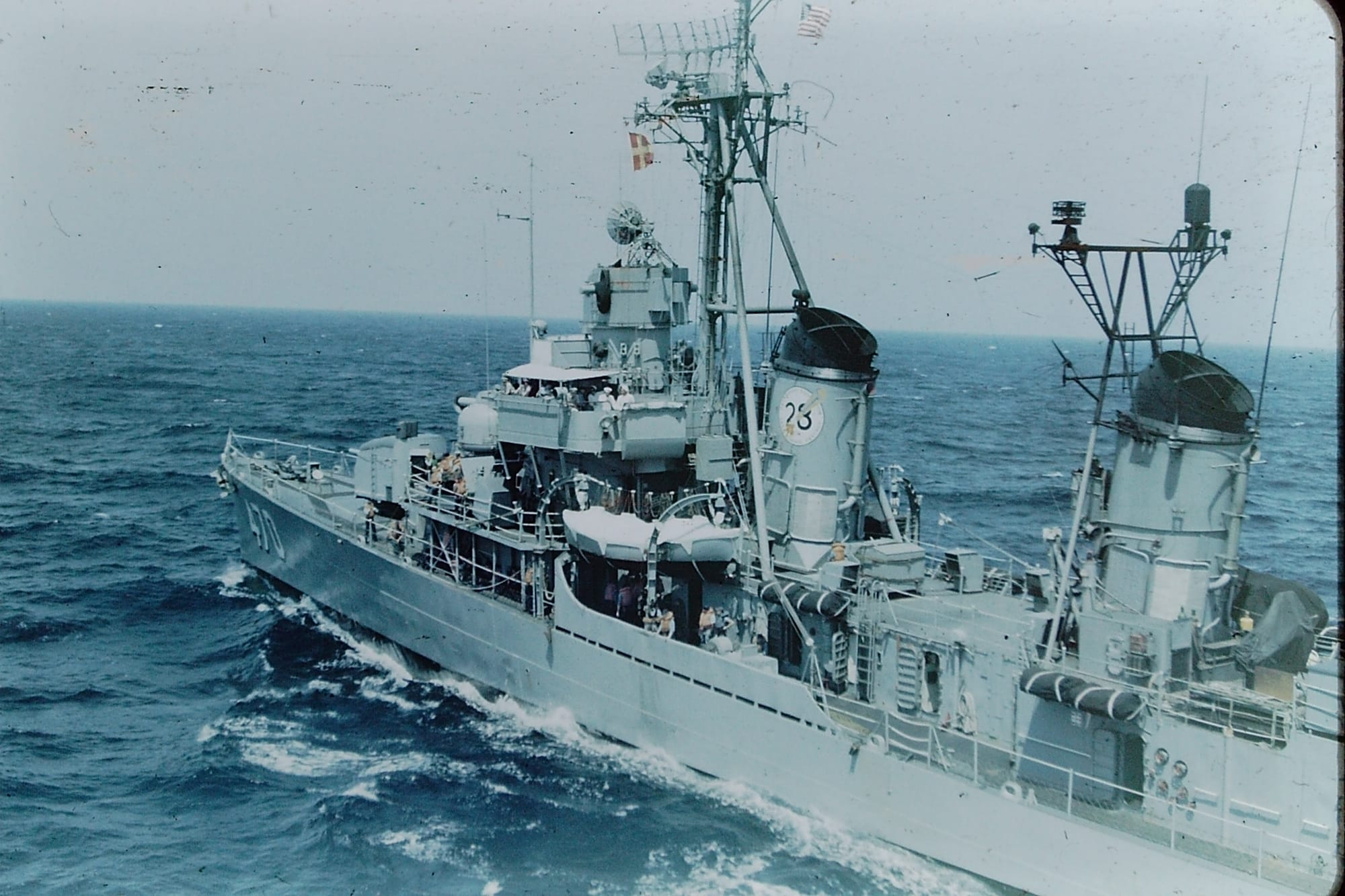
During the exercises, we practiced going to General Quarters [GQ (battle stations)] with the ship buttoned up tight—all hatches closed and secured to minimize flooding in the event of battle damage. My GQ station was a tiny, 4x4 ft, broom-closet like space that housed our crypto (cipher) device. It was next to the CIC (Combat Information Center).
During these exercises, however, I had nothing to do. Radio traffic was minimal and not encrypted. What a Godsend. The crypto space was claustrophobic and unbearably stuffy with the door closed and locked (a requirement, but especially so, when operating the crypto machine). I spent my time on the bridge or in CIC. Usually, GQ was relaxed within thirty minutes to facilitate shipboard life.
We spent long, weary hours searching by pinging (sending out strong sound waves that would bounce back if they hit a submarine). An echo off a sub would give us approximate range, depth and bearing. When not actively pinging, we would go to passive mode and listen only. Once a contact was made we would move closer and begin aggressively pinging—sending out a pulse every 20 seconds. A submarine friend told me later that our pings were physically punishing when we got near.
He said that they were strong enough to bounce a plate off a table. He likened it to being in a steel drum receiving hits by a sledgehammer—no physical injury but painful nonetheless.
On the tenth day of the exercise, we were exhausted and bored out of our minds from executing endless search patterns. Suddenly, the radio came alive as a helicopter, using dipping sonar to confirm a MAD contact, reported, “I’ve got one!
I’ve go one! He’s not one of ours. Repeat, not one of ours.”
“Alpha 3 and 4. He’s yours,” This order from the Squadron Commander was the Conway and Waller’s authority to detach and pursue the unidentified contact, northwest about eighteen miles away.
Abruptly, it seemed that everyone had received a jolt of adrenaline. This was real. We could get our teeth into it. Lieutenant Junior Grade (Ltjg) Joe Judge, our ASW officer, pounded his console and yelled, “Hot damn! Let’s get the bastard.”
We tore off at flank speed (about 36 knots). In the distance, we saw two more helicopters joining the one reporting the contact. We were hoping that we had a Soviet sub. Thus began our efforts to force an unidentified submarine to the surface or to use its snorkel (intake/exhaust, periscope-like device used to run it’s main engines and recharge batteries). Compelling the sub to acknowledge detection (by surfacing or using his snorkel) was a coup for us but a disgrace for the sub. Both the US and Soviets took these games seriously during the cold war. (To my knowledge, the Soviets never forced a US submarine to surface or use its snorkel. We fared better with seven confirmed incidents, at that time.)
Over our speaker came, “Alpha 3 and 4, slow down. You’re making too much noise. We can’t hear anything. Charlie 2 (the helicopter on the contact) out.”
We reduced speed to five knots and were rewarded with, “That’s much better. I hear him again. He’s moving northwest about four knots, depth near 170 ft.”
The ASW officer in Charlie 2 had assumed tactical command. He positioned the Conway, Waller, Basche and Beale in a box formation about 800 yards apart. Charlie two was in the middle and was relieved every twenty minutes by Charlie 3 or 4.
At irregular intervals, from mere seconds to minutes, one of the DE’s would ping the unidentified submarine.
Over the next three hours, our mysterious, underwater contact made four attempts to escape. He changed directions and depths, looking for a cold thermal layer that would distort our pings enough to permit him to slip away. Failing to elude us, he went silent and hung motionlessly 250 feet below. He hoped we’d relax and he could leave undetected. On the Conway, we ran firing solution after firing solution on our attack computer—really a primitive (by 2004 standards), mechanical, electrically driven device used to calculate firing data that was fed automatically into our weapon alpha missile.
The cat (us) had the mouse (sub) cornered when our radio squawked, “Break contact, reform and come to course 214. We are heading into heavy weather. I say again, break contact. Reform on course 214. Heavy weather ahead.”
Even in calm seas, destroyers tend to be nervous and skittish ships—they pitch and roll more violently than larger ships. In heavy weather, there’s not an atheist aboard. Everybody, without exception, prays. It’s fear induced by terror.
On the bridge, I noticed that the wind had picked up strongly; the sky grew dark and foreboding. The old Conway began burrowing her bow in the sea—down and up again like a toy, rocking horse sending sheets of water over the bridge.
The CO gave the order to button down all hatches and that no one go topside without a life jacket and secured by a lifeline. We were in for a rough go. As time passed, all we could do was hang on and brace ourselves. The waves kept getting bigger and bigger. I liken it to being in a hole and looking up with water thirty feet above, in every direction.
Then, the ship began to move up and up, faster and faster. Suddenly, we were on an alpine crest with a valley far below the bow. Down and down we’d plunge to bury the bow up to the forward gun mount; the Conway would shake off the water and take an express elevator to the top of the next, monster wave. Our ship did this again and again. It reminded me of a roller coaster, thrill ride.
That day I had witnessed a flat sea transformed into a mountainous region of towering peaks and deep, narrow valleys where the topography changed moment by moment. Lightening crisscrossed the sky in a spider web of cold, sinister streaks.
Thunder cracked in one long drum roll after another keeping time for nature’s tantrum.
Hour after hour, we fought the storm. Frightening as being on the bridge was, inside it was worse. The ship grew stuffy and the air foul smelling. Anything not tied down slammed about. Most of the crew was sick and moaning in their bunks. Slowly, ever so slowly, the wind dropped and the sea quieted. The clouds parted and a pale half-moon hung in the sky turning the water into a million sparkling diamonds. Only then did I notice that my arms and legs ached. I discovered several bruises from being thrown into steel bulkheads or other equally unmovable objects. (On a Navy ship, everything is hard and unforgiving.)
Although I was very tired, I remained on the bridge, glad to be alive. Gradually, it dawned on me that the Conway was doing a waltz with the sea to a slow one, two, three, four count: down (one), roll to port (two), up (three), roll to starboard (four) and so on. The Conway sailed at an easy eight knots happy with this new, gentle rhythm. On the bridge at 0230, everyone was quiet, lost in his thoughts. I remember feeling lonely and missing my parents and sister.
The Commodore suspended the ASW exercises that morning. Our CO ordered a general field day fore and aft to clean the ship inside and repair storm damage. I had a full day ahead inspecting the galley and mess decks and preparing payday for the crew.
Assisted by chief pharmacist mate Allen and commissary chief Moore, I inspected the galley and all food handlers. The spaces were spotless as they should have been. CPO Allen dismissed several food handlers because of cuts and abrasions on their hands and forearms. Over the years the Navy had learned how devastating food poisoning and viral infections could be to a crew living in close, confined spaces. Inspection of food preparation areas and food handlers was a daily, high priority task with our small medical department. We took no chances with cleanliness and hygiene.
At sea, physical cleanliness was a problem on the Conway because we always went on water hours. Our ancient evaporators had trouble keeping up with the demand for water by our boilers. Consequently, fresh water to the showers was rationed and turned on for only 30 minutes every twelve hours. Taking a Navy shower meant getting wet, turn off the water, lather all over, and turn on the water for a brief rinsing. The whole process should take less than two minutes or your shipmates would complain. Of course one always had the option of taking saltwater (seawater) showers. I would not recommend that option.
My first payday at sea went well. We—SK1 Durig, DK3 Welsh and I—paid the crew on the mess decks, the chiefs in the chiefs’ mess and the officers in the wardroom. Welsh read off the amount due from the pay record; I verified the man’s ID and his signed pay chit and counted out his money; SK1 Durig recounted the money and handed it to the man. In total we paid the officers and men about $17,000 as I recall. What a relief when the pay chits, the pay records and the money balanced. I finished just in time to make evening meal in the wardroom. This was my first opportunity at a sit down dinner with the CO.
On the Conway under Cdr. Baker, the custom at sea and in port was for all officers not on duty or excused to eat evening meal with the CO. We would arrive well ahead of 1800 and stand behind our assigned seats waiting for the CO. He would enter and give us permission to sit. The CO sat at the head of the table with the XO to his immediate right and the Operations officer to his immediate left. The other, more junior officers alternated down to the end of the table where I, as president of the mess, sat facing the CO. (The president of the mess approved the menus, prepared the monthly mess bills, collected money owed, requisitioned food stores from vendors when in port or from the general mess at sea.)
As we waited standing behind our seats, Ens. Ted Dyer, a Naval Academy Classmate, turned towards me and whispered, “Whatever you do, don’t look at the CO’s upper lip. If he asks you something, stay focused on a spot above his right eye when answering.”
Before I had a chance to ask Ted what he meant, the CO walked in and told us to sit down. From his scowl, I knew that he was in a foul mood; and I understood the reason for Ted’s cautionary tip.
Cdr. Baker’s upper lip appeared swollen to three times normal size; the hairs of his mustache stuck straight out in all directions resembling a scrub brush. His appearance was fall-down laughing and it was all I could do to suppress a smile. Before seating us, he stared at each in turn as if daring anyone to notice. Not a word was spoken during the meal. We looked down at our plates. The bristle brush under the CO’s nose moved up and down slowly as he chewed. Recalling that strange sight causes me to chuckle even today.
After dinner, Ted explained, “When the CO is stressed, his lip swells. Usually, it lasts 24 to 48 hours. The crew thinks it’s funny but we (meaning the officers) stay clear.”
“Does he take medication?”
“I don’t know,” said Ted, “Listen Cal, he has a vicious temper. Worse, he doesn’t overlook or forget anything. Six months ago, two reserves [Lieutenant Commanders (LCDR’s)] reported to fulfill their two-week (per year) active duty requirements. The Captain had one of his spells. At dinner, one of the reserves commented about his lip, saying that it looked painful. Cdr. Baker said, ‘It’s none of your god damn business.”
“That must have been embarrassing.”
“Embarrassment is the least of it. The CO’s yeoman told me later that the Captain gave one of the reserves an unsatisfactory fitness report. Guess which one it was?”
“Thanks for the warning, Ted. I appreciate it.”
Member discussion