They Invariably Confess
Clipping Transcript
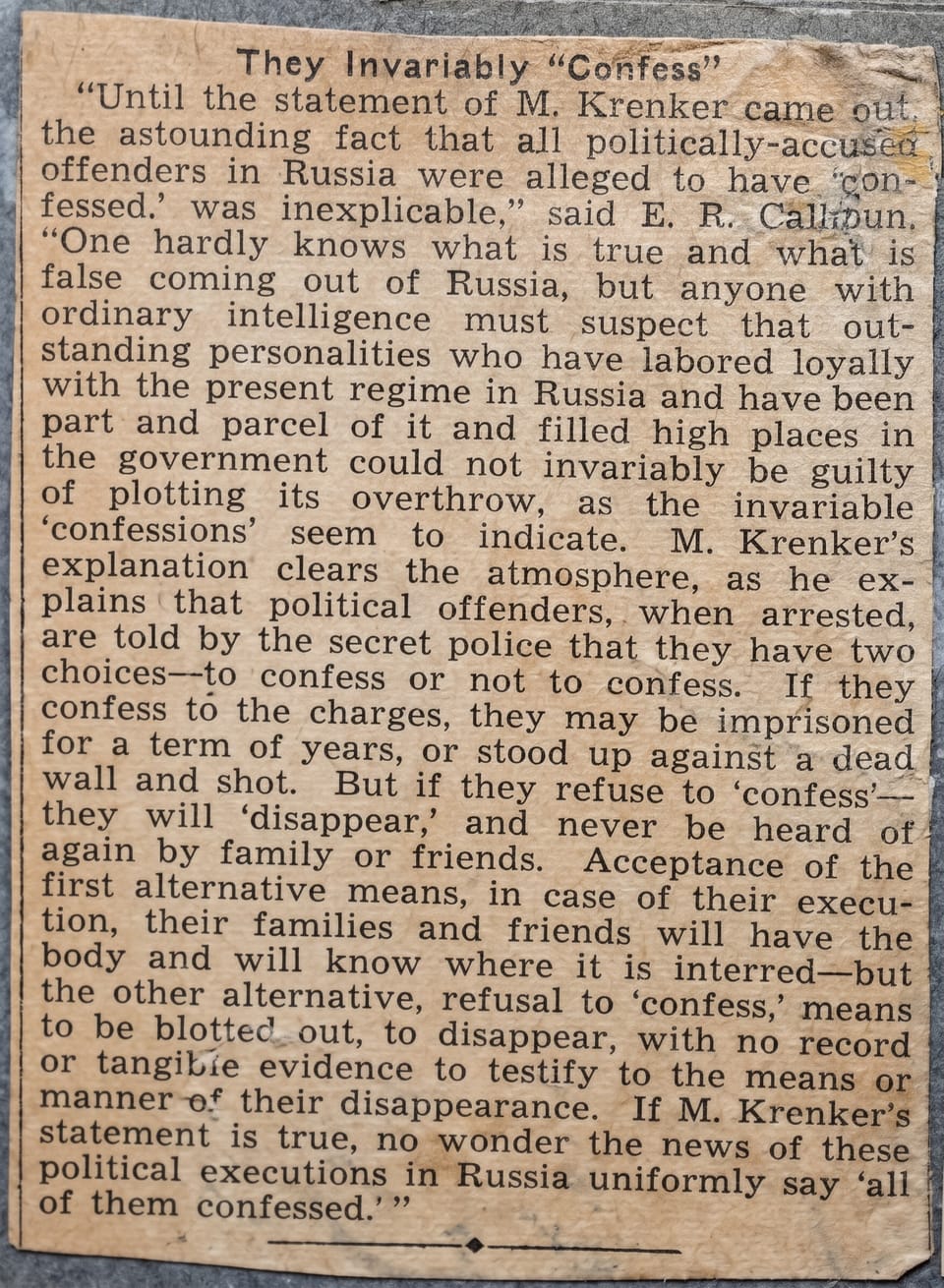
"Until the statement of M. Krenker came out the astounding fact that all politically-accused offenders in Russia were alleged to have 'confessed,' was inexplicable," said E. R. Calhoun.
"One hardly knows what is true and what is false coming out of Russia, but anyone with ordinary intelligence must suspect that outstanding personalities who have labored loyally with the present regime in Russia and have been part and parcel of it and filled high places in the government could not invariably be guilty of plotting its overthrow, as the invariable 'confessions' seem to indicate.
M. Krenker's explanation clears the atmosphere, as he explains that political offenders, when arrested, are told by the secret police that they have two choices—to confess or not to confess. If they confess to the charges, they may be imprisoned for a term of years, or stood up against a dead wall and shot.
But if they refuse to 'confess' they will 'disappear,' and never be heard of again by family or friends. Acceptance of the first alternative means, in case of their execution, their families and friends will have the body and will know where it is interred—but the other alternative, refusal to 'confess,' means to be blotted out, to disappear, with no record or tangible evidence to testify to the means or manner of their disappearance.
If M. Krenker's statement is true, no wonder the news of these political executions in Russia uniformly say 'all of them confessed.'"
Historical Context
E. R. Calhoun looked at the Moscow trials in the late 1930's with plain common sense. He saw old revolutionaries who had spent their entire adult lives building the Soviet Union, men who had run government ministries and commanded armies, suddenly marching into courtrooms to accuse themselves of bizarre crimes. They claimed they had sabotaged grain harvests, taken orders from foreign spies, and plotted to murder their own comrades. Calhoun knew this defied basic logic. Men who build a regime from scratch do not all wake up one morning and decide to destroy it.
To explain the mystery, Calhoun leaned on an account from a man named Krenker. The theory made intuitive sense to an outsider. It claimed the secret police offered prisoners a grim trade. If you confessed, you faced a bullet or a prison sentence, but your family received your body and a marked grave. If you refused, you were erased into thin air, leaving no record and no closure for the people you loved. It was a neat, rational explanation, relying on the universal human desire to be buried with dignity.
The reality uncovered decades later showed that Calhoun and Krenker were far too generous to the Soviet state.
The secret police never handed bodies over to grieving families. When the condemned men were taken to the basements of Lubyanka prison and shot in the back of the head, their remains were loaded onto trucks under tarpaulins and burned in municipal crematoriums. The ashes were dumped into mass, unmarked pits. Relatives were handed a standard slip of paper declaring the prisoner had been sentenced to ten years of hard labor without the right to write letters. It was a cruel fiction meant to keep wives and children waiting for men who had already been buried in lime pits for years.
The real machinery that produced those courtroom confessions was far more brutal than an argument over burial plots. Interrogators ran prisoners through a meat grinder known as the conveyor, keeping them standing under blistering heat lamps for consecutive days and nights. They worked in shifts, rotating fresh investigators every eight hours while the prisoner slowly collapsed from sheer exhaustion, hallucinations, and kidney failure.
When physical torment failed, the police brought out signed arrest warrants for the prisoner's family. They held wives, teenage daughters, and young sons hostage in adjacent cells. A man who was entirely prepared to die for his political beliefs would sign any sheet of fabricated nonsense if it meant his fifteen-year-old child might be sent to an orphanage instead of a labor camp.
Calhoun’s brief column captures an ordinary citizen watching horror unfold from across an ocean. He could see that the official news reports were hollow propaganda, even if he could not yet imagine how deep the cruelty really went.
Member discussion