. . . And In Our Own Bldg
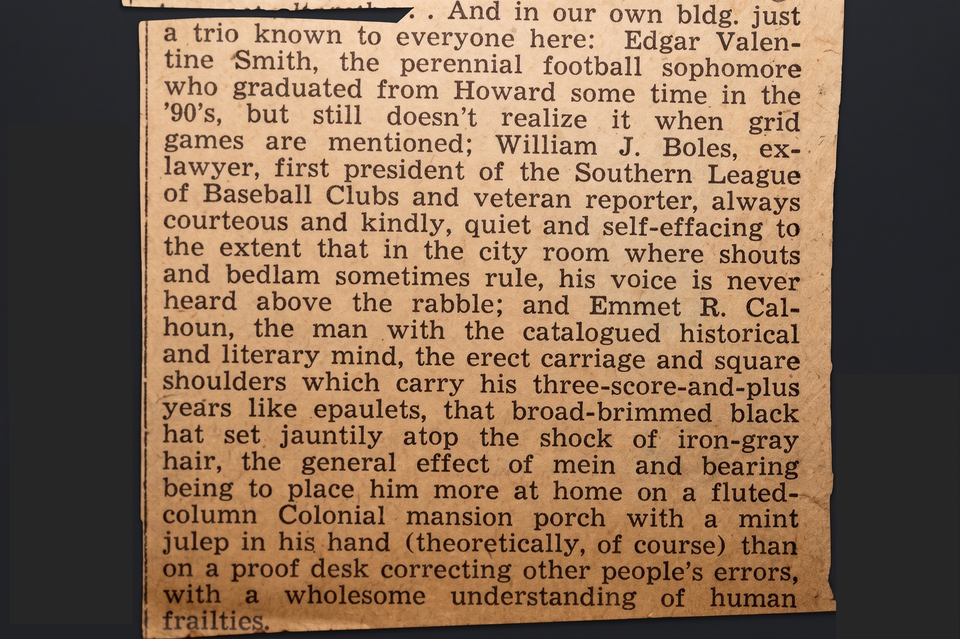
Text Transcription
Historical Analysis
Step inside Fourth Avenue North and Nineteenth Street in the early 1930s, and the first thing that hits you isn’t the romance of the Fourth Estate. It is the sheer, concussive racket. Up above, amid the clatter of typewriters, the shouts across desks, and the relentless clink of Linotypes setting hot lead, three men anchored the whole operation.
To keep pace with the city's growth, the paper operated an enormous mechanical works directly beneath the editorial floor. According to trade records from 1926,[2] the pressroom ran a massive configuration of high-speed units, each turning out 16-page sections. Combined, the plant boasted a daily production capacity of 78,000 copies (93,000 on Sundays), a staggering volume required to feed the Magic City's swelling workforce.
This little profile catches a rare, quiet moment of reverence in that noisy shop, giving a nod to the veteran trio who gave the sheet its backbone, its institutional memory, and its classical polish.
Edgar Valentine Smith: The Football Sophomore with an O. Henry
The room still ribbed him as the “perennial football sophomore” because he had played at Howard College (now Samford) back in the leather-helmeted 1890s and never quite got the game out of his blood. Around Alabama, however, Edgar Valentine Smith was much more than a desk editor nursing autumn nostalgia. In 1923, he brought national literary prestige home to Birmingham by winning the O. Henry Memorial Award for “Prelude,” his piercing, dust-and-pine-needles portrait of Selina Jo and life in the deep timber country. To have a nationally recognized stylist sitting right there in the city room, casually tracking college football scores between deadlines, gave the younger reporters an inkling of what real craftsmanship looked like.
William J. Boles: The Gentleman of the Press
In an ink-stained bullpen where rough talk and posturing were practically part of the style guide, William J. Boles stood out like a quiet churchman. Born in a rural one-room schoolhouse and blooded in the field as a lieutenant with the 3rd Alabama Infantry during the Spanish-American War, Boles had forgotten more state politics than most reporters would ever learn. He was a pioneer in Southern sports as well, having helped steer the Southern League of Baseball Clubs. When minor league baseball organized that historic 1901 circuit, featuring teams in Birmingham, New Orleans, Nashville, Little Rock, Memphis, Selma, Shreveport, and Chattanooga, Boles served as their first president. By 1932, he channeled a vast reservoir of local lore into his beloved daily column, “This Date in Alabama History.” Amid the midday deadline bedlam, while younger men shouted themselves hoarse, Boles never raised his voice. He simply leaned over his desk, courteous to a fault, letting his clean, unhurried copy speak for him.
Emmet Rodwell Calhoun: The Courtly Citadel of the Proof Desk
Guarding the gate between careless phrasing and tomorrow morning's printed form sat E.R. Calhoun. In a shop hurtling at breakneck speed, Calhoun looked as though he had stepped right off the shaded veranda of an antebellum homestead. He wore a broad-brimmed black hat tilted jauntily across a shock of iron-gray hair, carrying his sixty-odd years with the erect, squared-shouldered dignity of a military officer.
Calhoun was not just catching misplaced commas. As the chief proofreader, he was the paper’s supreme court of fact, geography, and classical grammar before the cylinders locked. He possessed an encyclopedic memory of the Old South, an era whose vanishing stories he was just beginning to set down on paper, paired with a generous, dry patience for ordinary human slip-ups. While the roaring Magic City outside was all coal dust, steel mills, and forward march, Calhoun sat by the linotype forms with his pencil, keeping the proper English and the Southern memory intact.
- I would like to believe E.R. did NOT proofread this little profile. ↩︎
- View the digitized issue of the November 3, 1926, edition of Advertising & Selling via the World Radio History Archive. The full-page feature detailing the paper's physical growth, titled “The News Grows with Birmingham,” appears on page 11. ↩︎
Member discussion