West Coast Trip and Sleeping Bears
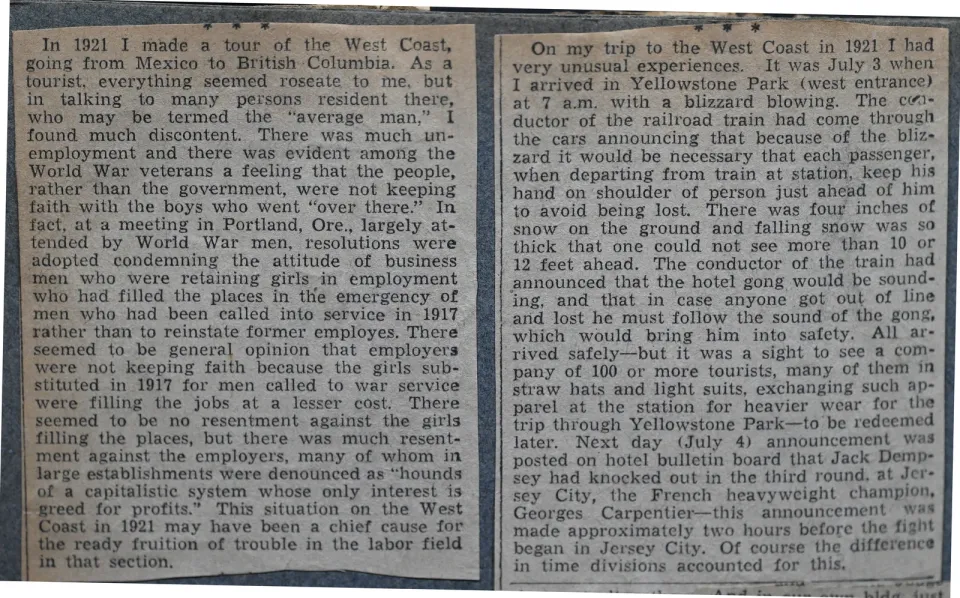
Clipping transcript
Left Column:
Right Column:
Historical Context
A young soldier returning to Oregon in the summer of 1921 did not step into the carefree, jazz-fueled prosperity textbooks usually associate with the Roaring Twenties; he walked straight into an employment line outside a locked gate.
This story cuts straight past the tourist postcard to expose the grinding social whiplash of the post-World War I Pacific Northwest. When the United States entered the war in 1917, millions of young men were mobilized, leaving deep vacancies in commercial offices, department stores, and rail depots. Women stepped into those vacant positions out of civic duty and economic need. But when wartime orders ceased, the nation plunged into the sharp, severe Depression of 1920–1921. Over four million Americans found themselves out of work, farm commodity prices collapsed, and businesses scrambled to cut overhead.
The friction described at the Portland veteran meeting reveals the bitter math of that postwar adjustment. Business owners who had waved American flags in 1917 refused to fire their newer female clerical staff to rehire returning servicemen, not out of any progressive urge for gender equality, but because women could be paid significantly less. The anger of these unemployed dough-boys was not aimed at the women holding the ledgers; it was directed squarely upward at corporate owners branded as war profiteers. The Pacific Northwest was already a hotbed of militant labor activism, with the radical Industrial Workers of the World and the general strikes of 1919 still fresh in public memory. Seeing companies sacrifice returning soldiers for cheaper payroll confirmed their deepest suspicions that the economic system was rigged.
The right-hand column offers a sharp, amusing contrast to that street-level bitterness, capturing the peculiar growing pains of a modernizing America. The scene at the Yellowstone rail depot shows the chaos of early transcontinental tourism: affluent city travelers filing out of Pullman passenger cars into a mountain blizzard, clutching straw boater hats and light seersucker suits while holding onto the coats ahead of them in a blind march guided by a brass hotel gong. Based on the description, he most likely arrived at the Union Pacific Rail Depot in West Yellowstone, Montana. The passenger tracks ended along Yellowstone Avenue, placing disembarking passengers only about 200 feet (roughly 60–70 yards) across the street from the town’s commercial lodge row. Sadly, I have yet to uncover any more details about the lodging for his stay.
Now on to the story of the fight announcement. On July 2, 1921, heavyweight champion Jack Dempsey knocked out French challenger Georges Carpentier in Jersey City in front of 90,000 spectators, creating the world’s first million-dollar gate. Because western telegram networks and the telegraph wires running along the rails outpaced the sun across four standardized time zones, guests at the park knew Carpentier was on the canvas before the local clock even matched the New Jersey start time. It is a snapshot of an emerging, interconnected national culture, one where high-speed telegraphs and sports frenzies could paper over an economy struggling to repay the men it had sent to war.
For a look at the spectacle mentioned on that hotel bulletin board, you can watch archival footage of the Jack Dempsey vs Georges Carpentier fight. This newsreel shows the exact July 1921 Jersey City bout whose wire result astonished the snowbound tourists in Yellowstone. We know today that Dempsey won in the fourth round, not the third as stated in E.R.'s column. Whether he misremembered or whether the posted bulletin was wrong, I'll leave that for you to decide.
And a little something extra
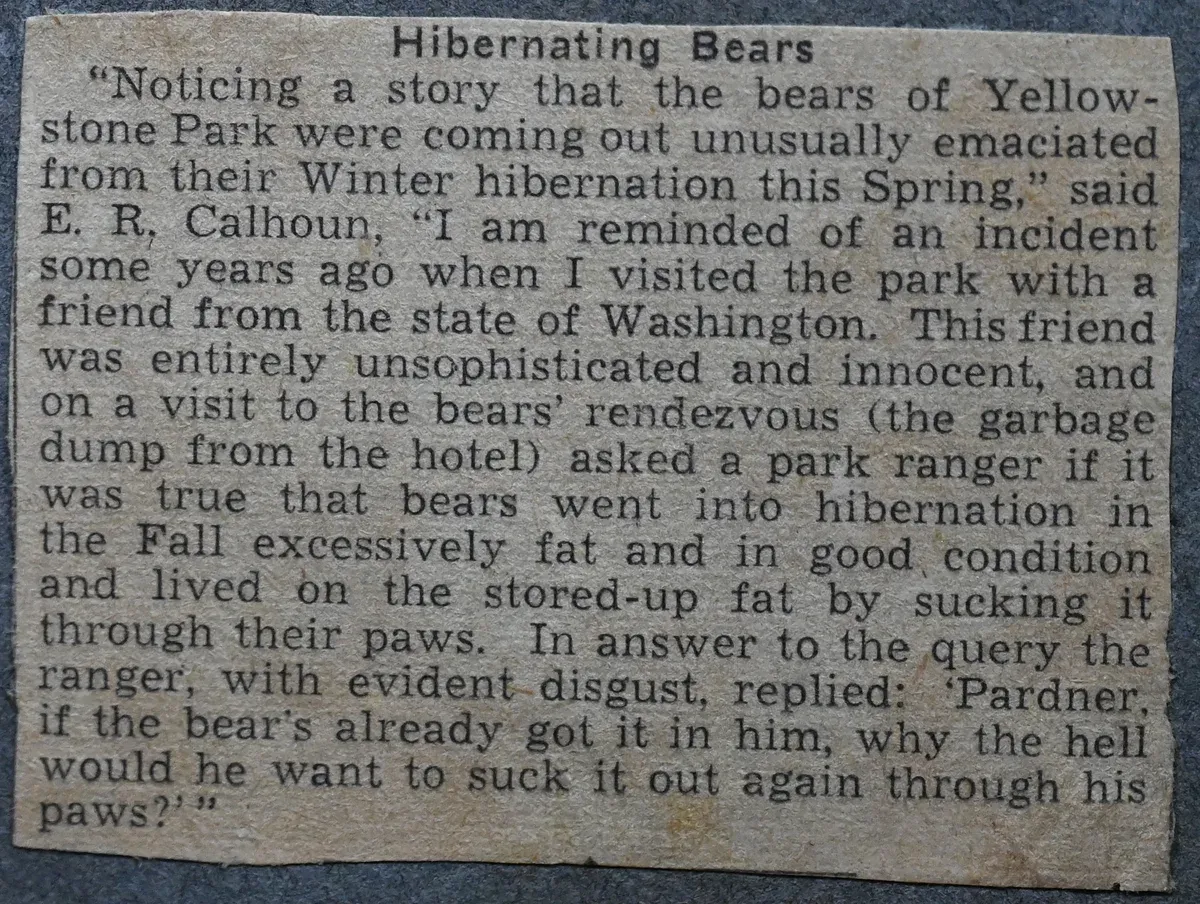
Photo Transcription
Historical Analysis
About five or six years after the story of his trip west, on the occasion of a news story on the Yellowstone bears coming out of hibernation, E.R. flashed back to the trip west one more time. The story of the "bears’ rendezvous at the garbage dump" drops modern readers into a wild, lost chapter of American wildlife management.
Throughout the 1920s, hotel food waste in Yellowstone was not hauled to incinerators or locked inside steel, bear-proof containers. Hotel operations simply emptied kitchen scrap barrels into open pits behind massive lodges like the Old Faithful Inn and the Lake Hotel. Dozens of grizzlies and black bears congregated every dusk to tear through rotting beef bones and melon rinds. Rather than running visitors away from these carnivore buffets, the park system leaned directly into the spectacle. The National Park Service built elevated wooden bleachers, posted armed rangers on horseback as nervous sentries, and formally advertised the open-pit dumps as evening dinner entertainment. Tourists in fedoras and evening dresses sat fifty yards away, watching massive predators squabble over kitchen table leavings in broad daylight. That roadside carny atmosphere endured for decades before park biologists forced the dumps shut in the early 1970s to eliminate human-food conditioning.
The companion's naive question, meanwhile, reached back through centuries of frontier folklore. The belief that denning bears sustain themselves by sucking their paws was an astonishingly durable folk myth dating back to Roman naturalist Pliny the Elder and Renaissance bestiaries. Early European and American woodsmen observed bears in late winter licking their foot pads, assuming the animals were extracting concentrated grease or fat stored during the autumn binge. In biological reality, bears undergo seasonal desquamation during dormancy, licking their paws simply to slough off cracked, peeling skin pads as fresh tissue grows underneath.
The dry, profane puncture of that superstition captures early ranger culture at its most pragmatic. The ranger's coarse skepticism reflects the clash between raw Western experience and gullible Eastern park-goers who brought antiquated folk tales and storybook ideas of nature straight into grizzly country.
For historical documentation of how visitors used to view these staged feedings, you can watch archival footage showing Feeding Bears at the Park Garbage Dump in Yellowstone circa 1930s. This silent reel illustrates the exact open-pit feeding grounds behind park hotels where tourists routinely gathered to watch bears scavenge kitchen refuse.
Member discussion