Recollections from the Composing Room: The Scrapbook of E. R. Calhoun (1870–1943)
By Rod C. Johnson
For as long as I can remember, my dad carried a bag of some sort or another. Nowadays folks on the internet love to brag about their “Everyday Carry” while meticulously laying out titanium pocketknives, flashlights, and pry bars on social media. Back in the mid-1960s, if you were to ask my dad what his everyday carry was, he would just reach into that satchel and start setting things on the table.
First came a notebook, whether a legal pad, a steno tablet, or a little wire-bound spiral that could tuck neatly into a front shirt pocket. Next was a handful of pencils, both standard graphite and colored grading leads, along with a couple of good ink pens. Beside those sat a dog-eared Louis L’Amour western paperback and a few packs of chewing gum. If the current pad was even half full, you could bet a crisp new notebook was tucked behind it, ready to step in. Anytime Dad found himself sitting in the car or waiting on a bench for Mom, which happened with comfortable regularity, out would come a pencil, and he would be scribbling away in the margins.
I watched him do it for years before I finally asked, “Dad, why are you always writing?"
He looked up from the page, gave me that familiar look, and said, “Well, Roddy, my grandfather worked for a newspaper and he was always writing. I guess the habit just stuck with me.”
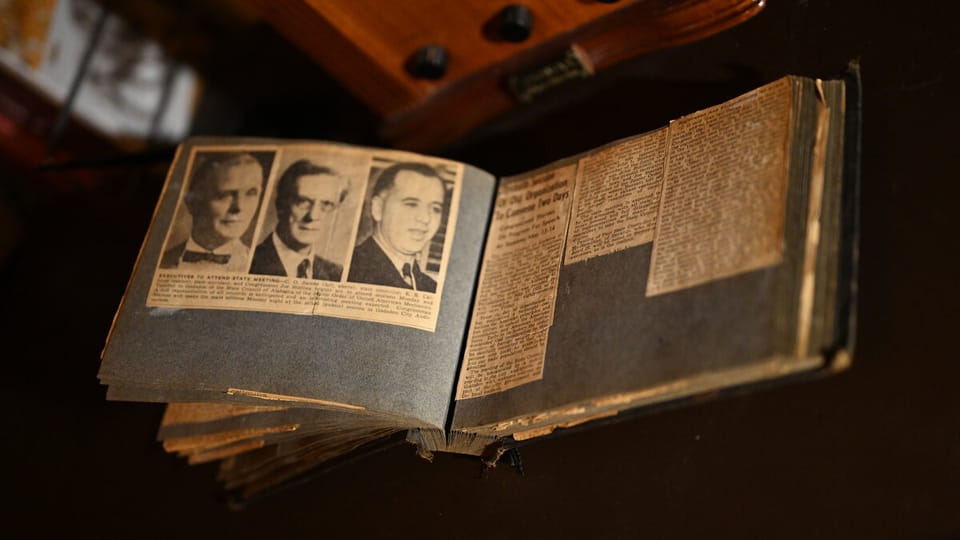
Now that Dad is in his nineties, he doesn’t fill legal pads the way he used to. But believe me when I say our home is filled to the ceiling with notebooks, faded photographs, and family scrapbooks. A couple of years ago, when I moved back in with Mom and Dad to help look after them, I set up my workspace in Dad's old office. Sitting there between shifts, staring at the floor-to-ceiling bookshelves lining the walls, my eyes kept landing on one particular volume: a modest little scrapbook held together with a loop of hand-tied string. I must have looked past that binder a hundred times without ever touching it.
Then, a few weeks ago, at the tail end of a long, quiet shift while waiting for a work call to come through, I reached up and pulled that string-tied book off the shelf.
Opening it was like cracking open a time capsule. Pasted onto the pages were columns of yellowed newsprint, with type set so dense that each line of lead seemed to rest directly on the shoulders of the one below it. I’m not too proud to admit that my eyes aren’t quite up to squinting at eighty-year-old eight-point font anymore, so I pulled out my phone to snap a photo and blow up the image. But right then, modern technology stepped in when a prompt popped up on the screen asking, “Would you like to transcribe the words in this photo to text?”
I tapped “yes”, and down the rabbit hole I went, a journey worthy of Alice herself. And right there in the middle of it, I met my great-grandfather.
The Man Behind the Pencil
For forty years, Emmet Rodwell Calhoun sat at the quiet center of Alabama journalism.
From 1901 until his retirement in the summer of 1941, he was the head proofreader for The Birmingham News. While reporters chased fire engines through Jones Valley and editorial writers hammered out political endorsements, Emmet presided under the green lampshade on Fourth Avenue North. Armed with a sharp pencil and an iron standard of English grammar, he caught fractured dates, untangled syntax, and served as the court of last resort before the heavy rotary presses started shaking the sidewalk below.
Behind that pencil was a scholar’s mind, stocked with classical Latin and Greek, an encyclopedic memory of the post-Reconstruction South, and a lifetime of his own adventures. Before he ever moved to the Magic City, he had grown up along the Tombigbee River in Columbus, Mississippi, drilled under Captain Thaddeus Belsher at the University of Columbus, and edited The West Alabamian in Carrollton. Over in Pickens County, he ran county-seat political conventions during the fiery Populist campaigns of 1896 and helped organize the short-line railroad that eventually became the Alabama, Tennessee & Northern.
In his later years, Emmet took up his own pen. Under the headings “Views and Interviews” and “Recollections,” he began capturing the vanishing oral history of his youth: streetcar strikes, delta axe-men, frontier gun battles, runaway political carriages, and early radio broadcasts heard from his home on Red Mountain.
His daughter, my grandmother, carefully clipped each column from the morning paper and pasted them into that string-tied binder. For whatever reason, these stories held enough weight for her to curate and preserve them, leaving behind fifty-two published dispatches that span from roughly 1932 to 1943.
I hope at least a few people will enjoy this window into a world now three generations into my past.
About This 52-Week Series
Beginning this week, I am publishing all fifty-two clippings from Emmet Calhoun’s scrapbook on a steady weekly cadence.
Each Sunday dispatch includes:
- A high-resolution photograph of the original yellowed newsprint clipping, preserving the texture of the page.
- A faithful transcription of the text exactly as it appeared in The Birmingham News.
- Historical notes and analysis, tracing the forgotten figures, local landmarks, and regional disputes that framed Emmet’s writing.
A Call for Context: Help Us Fill in the Margins
History is never truly preserved in isolation; it lives in old cedar chests, courthouse basements, family Bibles, and the stories passed down around kitchen tables.
Throughout these dispatches, Emmet names hundreds of nineteenth- and early-twentieth-century Southern figures: country doctors, liverymen, Confederate veterans, early union printers, railroad surveyors, and county merchants.
If you are a local historian, genealogist, or family descendant with additional information, photographs, corrections, or stories about the people and places mentioned in these columns, please feel free to contribute:
- Leave a comment at the bottom of any dispatch to add your family notes to the public record.
- Email me directly if you have scans of letters, photographs, or family records you would like referenced in the historical footnotes.
Every clipping will remain an active, living document, and valuable reader contributions will be credited and incorporated as the series unfolds.
The 52-Week Master Index
Below is the complete chronological roadmap for the project. Links will become active each week as new dispatches go live.
Volume I: The Composing Room & The Wide World (1932–1938)
- Week 1: . . . And In Our Own Bldg. (Newsroom Portraits: E. V. Smith, W. J. Boles, and E. R. Calhoun)
- Week 2: Post-Repeal New England Travel Dispatch on Liquor Sales (1934)
- Week 3: Haircutting Is Art Few Acquire (Montreal Travels and Cranial Geometry)
- Week 4: Alabama Sales Tax Debate & Reflections on Translating the Lord’s Prayer (1937)
- Week 5: They Invariably “Confess” (Stalin’s Purge Trials and M. Krenker's Testimony)
- Week 6: Yellowstone Bears and Western Wildlife (National Park Roadside Encounters)
- Week 7: A True Vindication of the South (Thomas M. Norwood vs. Gone With the Wind)
- Week 8: Is “Common Cold” Essential To Life? (Dr. Charles Baskerville’s Radical Biological Theory)
- Week 9: Glories of the Dawn: A Newsroom Reflection (The Night Shift and Morning over Red Mountain)
- Week 10: Review: Dr. R. R. Wyatt’s “Autobiography of a Little Man” (Rural Horseback Medicine)
Volume II: Iron Rails & County Politics (1938–1939)
- Week 11: A Campaign Memory Of ’96 (Capt. Joseph F. Johnston and the Pickens County “Jeffersonians”)
- Week 12: John T. Cochrane: A Builder Of Alabama (Editorial Tribute to the AT&N Founder)
- Week 13: John T. Cochrane And His Railroad (How a Carrollton Editor Sparked an Interstate Line)
- Week 14: Opposition to H.R. 6391 (Frances Perkins, Alien Deportations, and JOUAM Fraternal Policy)
- Week 15: Old Carrollton Personalities (The Local Backers of the Carrollton Short Line)
- Week 16: The Partition Of Czechoslovakia (Munich Appeasement and Historical Polish Warnings)
- Week 17: Mark Hodo’s Election & Capt. Dyer Hodo (Reconstruction Legal Service in Pickens County)
- Week 18: A Bronze Tablet For Vulcan (WPA Sandstone Tower and Col. Fred M. Jackson)
- Week 19: The Medieval “Baker’s Dozen” and Modern Food Profiteering (The Assize of Bread)
- Week 20: European Tax Burdens and Warnings from the Munich Crisis
Volume III: Gathering Storm & Local Memories (1939–1940)
- Week 21: Mr. Hildreth’s “Closed Shop” Bill (Alabama Industrial Labor Battles)
- Week 22: Those Who Live By The Sword (Hitler’s Reichstag Speech and the Invasion of Poland)
- Week 23: Du Chaillu And His Gorillas (Paul Du Chaillu, Gargantua the Ape, and the Field Museum)
- Week 24: Memories of Morris Karpeles and the 1880s Columbus Militia (“What is the Piece?”)
- Week 25: 1890s Pickens County Politics: John H. Bankhead’s Runaway Carriage and Gen. E. W. Pettus
- Week 26: Dr. Charles Baskerville And His Work (Appellate Judge Richard V. Evans Responds)
- Week 27: Recollections of a 1921 Western Tour (Portland Veteran Unrest and Dempsey vs. Carpentier)
- Week 28: Praise For A Native Bandmaster (Eugene Jordan and Early Birmingham Music)
- Week 29: Some Recollections: Lamar Fontaine, the “Daniel Boone” of Mississippi
- Week 30: The Beginning Of A Decade (New Year 1940 Newsroom Salute to Calhoun)
Volume IV: The Mississippi Delta & River Bottoms (1940)
- Week 31: Is This Prophecy, Speculation—Or? (The Fall of France and the “Hitler 666” Cipher)
- Week 32: Give England Every Support Possible (The Battle of Britain and Destroyers for Bases)
- Week 33: An Irish Filler Joke on a Scotsman (Composing-Room Humor)
- Week 34: Tribute to John C. Henley and Carrie Nation’s Newsroom Visit (Hatchet in the Office)
- Week 35: The 1884 Cleveland Election, Shooting Blacksmith Anvils, and the Sims Family
- Week 36: “Indian Tom” and Old “Chill” Henley (Choctaw Lore and Frontier Malaria)
- Week 37: Hooker & Oates’ Gloves, “Unanimous Buck,” and the Yazoo River Boom Chain
- Week 38: The 1874 Columbus Election Day Shooting and the Family Harness-Shop Secret
- Week 39: The Great 1882 Mississippi Flood, Snyder’s Bluff Refugees, and Kitchen Panthers
- Week 40: The Reconstruction Columbus Land Scheme and Old Charlie Baskerville’s Verdict
Volume V: The Dean Takes His Ease (1940–1943)
- Week 41: Jim Kelly, Speaker Charles Crisp, and the Misunderstood Doorkeeper Appointment
- Week 42: Wonderful Skill of Delta Timberjacks (Cypress Springboards vs. Vaudeville Choppers)
- Week 43: Old Plantation Services on the Radio (WSGN Sunday Broadcasts and the Wordless Chant)
- Week 44: The 1889 Greene County Fox Hunt, Hearthside Fireworks, and Planter Hospitality
- Week 45: Col. Arthur McClung, Gurley’s Guerrillas, and The Columbus Dispatch
- Week 46: Capt. Thaddeus Belsher’s Throat Beard and the Pickensville Knife Duel
- Week 47: E. R. Calhoun Enters Into Further Pursuit Of His Beloved Books (Retirement Biography)
- Week 48: A Veteran Takes His Ease (Lead Editorial Farewell to the Dean of Proofreaders)
- Week 49: The Iron Age, Frank P. O’Brien’s Press Foundation, and an Irish Mason's Revolt
- Week 50: Mayor Frank O’Brien, the Junior Order Flag Day Proclamation, and Insomnia
- Week 51: Walking Home on Laths: The 1907–1908 Birmingham Streetcar Strike with John Sparrow
- Week 52: An April-Fool Hoax Of Long Ago (Brigham Young’s Ghost Train at the Edwards House)
(Subscribe via RSS or sign up below to receive each Sunday’s dispatch directly in your inbox.)
Member discussion